For the past decade, MBA Polymers Inc., Richmond, Calif., has been working to answer that question in the affirmative.
Michael Biddle, an engineer who formerly worked for General Electric Co., Cummins (Engines) Inc. and Dow Chemical Co., founded a plastics recycling research and development and consulting firm in 1992. Two years later, he and co-founder Trip Allen turned that firm into today’s MBA Polymers, a California company that operates what is widely considered to be one of the most advanced plastics recycling plants in the world, recycling highly mixed plastic-rich residue generated by various durable goods recyclers in North America, Asia and Europe.
Progress, acknowledges Biddle, has been slow but steady. He estimates that some 10 million metric tons of durable goods plastics hit the scrap market or waste stream each year. His hope is that MBA can lead a charge that will create an established end market for this material.
A GROWTH PATTERN
Without question, manufacturers around the world are using more plastic to make their products with each passing year.
The trend has been especially noticeable from makers of computer equipment and small appliances. Televisions, audio equipment and other personal entertainment devices are encased almost exclusively in plastic now. The laptop computers that are increasingly replacing desktop and tower units have an even higher percentage of plastic than their predecessors.
Plastic components are being pressed, molded and extruded in record numbers, offering a voluminous stream of material to recyclers. Along with this blessing of high volume, however, is the challenge of a wide diversity of plastic resins and compounds used by manufacturers.
Since MBA’s origins, Biddle has been working with manufacturers to help them improve the recyclability of their products through their design and materials choices.
Several industries have made efforts to minimize the number of different resins they use, and—in the best cases—use a predominant resin in a particular product for purposes of easier recyclability.
But the stream of products made over the past two decades often consists of combinations of plastic types fastened together with screws, glues and other fasteners and adhesives.
SORTING IT OUT
The terms "shredding" and "downstream sorting" are most commonly linked to metals recycling, but MBA Polymers is among the companies moving plastic recycling toward the same model.
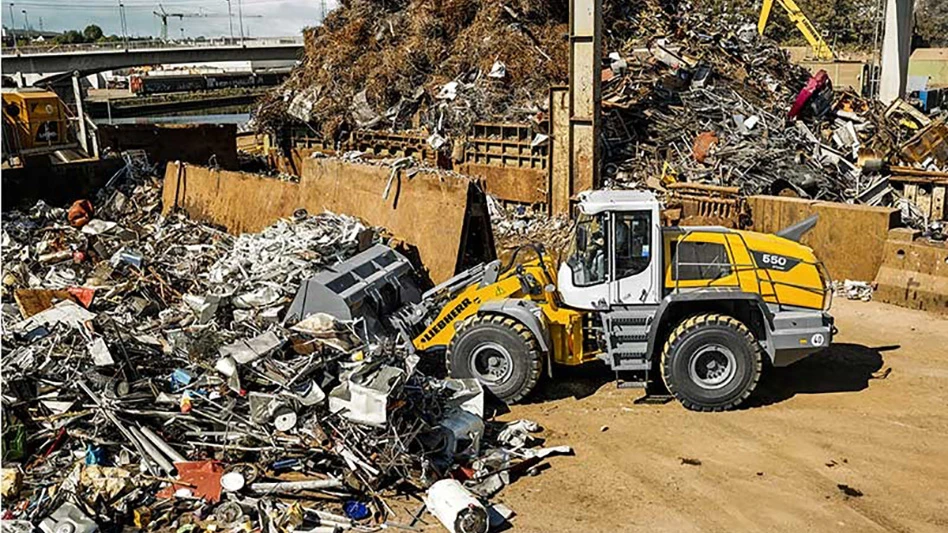
The company itself, though, does not usually shred. "The raw material we receive has most often already been shredded by a metals or electronics recycler," says Biddle. Material may come directly from auto shredder operators such as nearby Simsmetal America, or it may come from downstream separator operators such as Huron Valley Steel Corp., Belleville, Mich.
There is nothing easy about the sorting task facing MBA, especially for an operation that Biddle says accepts material derived from nearly anything with a cord, as well as quite a few things with engines.
The feedstock entering MBA’s Richmond plant comes from a variety of recyclers operating throughout the world. Although the pre-shredded material is largely nonmetallic, incoming material arrives in a variety of conditions and with a wide array of chemistries. "When we receive our material, some has as much as 10 percent metals content, while on the low-end it can have negligible amounts of metal."
While many scrap recyclers are in business primarily to harvest metal, MBA is producing a product that must be completely free of even metallic fragments, which would be considered a contaminant.
Thus, one of the first tasks facing MBA Polymers is removing and recovering the metallic portion of its incoming stream. Further downsizing and an array of mechanical sorting techniques, such as classification, magnets and other metal separation equipment, are deployed to remove the metals.
Further shredding and screening then takes place to separate different types of plastic from one another. "It is definitely complicated," Biddle says of the process of sorting the various plastic types. "Density sorting methods are not particularly helpful because most plastics are very close in density," he notes.
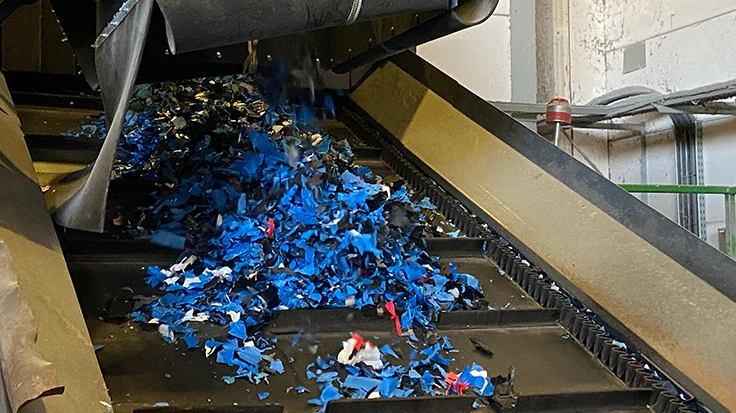
After the plastics have been shredded into small flakes, the series of separating steps takes place to sort plastics into resin groups that include polypropylene (PP), HIPS (high-impact polypropylene), ABS (acrylonitrile butadiene styrene), polycarbonate (PC) and PC/ABS blends.
Once separate streams of flakes have been created, the flakes can be extruded into cylindrical or spherical bb-sized pellets that can be used by plastics molding companies or original equipment manufacturers.
POINT A TO POINT B
In just a decade, MBA’s progress thus far has helped convince Biddle that both sufficient raw materials and sufficient end markets for MBA pellets exist to make the company’s model a successful one.
The challenge, to a large extent, is in the logistics: Ensuring the collection and shipping of sufficient raw materials to be used at the Richmond, Calif., plant. Quality is also a factor, as MBA would benefit from a cleaner stream.
"We can better develop a process that focuses on either electronic appliances, white goods or automotive plastics," says Biddle. "In North America they are often mixed into the same shredder, but that is changing," he notes.
In a narrower stream, Biddle comments, "It is easier to know what to look for and what contaminants to look for." For instance, the MBA separating process can be modified to be on the look out for rubber when auto shredder feedstock arrives, while more wiring and circuit board material can be expected when an electronics recycling stream is being processed.
Similarly, hazardous materials can be more closely watched out for when the source of material is known. Mercury is a possibility with auto shredder fluff while plastics containing brominated flame retardants must be sorted out with the MBA process when recycling electronics.
Preparing the MBA system for differences is even helpful if scrap metals shredder operators are willing to process autos and white goods separately. "Some operators will do it if it means they can recycle the plastic portion of the stream," says Biddle.
MBA’s executives and investors have contemplated running their own shredder as a means of ensuring a pre-separated stream of material, but thus far the company has decided against it. "A lot of people want to see us backward integrate—run our own shredder—but so far we have chosen not to. We’d rather work with the existing industry," he comments.
At the other end of the logistical puzzle is the guarantee that end markets (and the nearer the better) can be found for MBA’s secondary pellets. "Manufacturers in the electronics industry are starting to say, ‘We want to use recycled plastics,’" says Biddle. He also notes that American auto manufacturers began making moves to do this four or five years ago.
"They’re trying to get there," Biddle says of manufacturers and their ability to use secondary resins. He notes that the North American auto industry consumes about 4 billion pounds of plastic each year. "If they can reach a 25 percent use of recycled resins rate, that’s 1 billion pounds consumed annually."
Interest in using recycled plastics by electronics manufacturers has just started to accelerate, according to MBA. Flextronics, a Singapore-based company with U.S. headquarters in San Jose, Calif., has more than $13 billion in annual sales and is the largest contract electronics manufacturer in the world. Flextronics is also one of the largest injection molders in the world.
The company invested in MBA last year, according to Biddle, because it recognizes the increased interest in recycling from its large customers. MBA can help provide Flextronics with a unique service and product.
Steps taken and proposed in the European Union mandating pre-determined recycling rates for obsolete appliances and equipment offer one potential boost to the market. But Biddle says he does not necessarily favor such in-depth government involvement.
"As a company, we’re not a big proponent of such legislation," he comments. "At the same time, I can’t ignore that the legislation in Europe and Asia has helped us."
Biddle says the pending regulations in those parts of the world have spurred manufacturers to use more secondary resins and to expand collection of appliances and electronics. "Since April 2001, when Japan enacted its appliance recycling law, they have built almost overnight 35 different appliance recycling shredder facilities. They’re spitting out the material we want, and we’re able to get some of it."
The company has subsequently looked into opportunities to put facilities in those parts of the world. "Our most obvious areas of expansion are in Asia or Europe, because there is so much source material available. We would have to have partners that want to work with us in those markets," says Biddle.
Nonetheless, Biddle believes more plastics recycling can be accomplished in this part of the world without mandates. "I would prefer for industry in North America to do it themselves," he says of meeting recycling goals. "I’d like to see more collection mechanisms for anything with a cord," he says of the electronics segment.
"Realistically," Biddle points out, "somebody has to pay for the recycling of electronics and appliances because the material recovery alone will not pay for the collection and recycling costs. And in North America, landfill costs are so low that disposal avoidance is not a significant economic driver. The question that must be addressed is: Who is willing to pay and how much? Recent surveys have suggested that consumers in North America might be willing to pay something for disposal, but it’s not clear if it’s enough to cover all of the costs and they are not likely to pay without easy-to-use programs and/or legislative mandates like those in Europe and Japan. Once the electronics are collected, shredded and
the majority of the metal removed, we can economically recycle the plastics."
THE FUTURE IS NOW
Despite the encouraging growth that MBA Polymers has experienced, Biddle acknowledges that plastic recycling is still an industry where profit margins are thin, and profits themselves can be hard to come by.
"What to do with auto shredder residue is a common problem, and it’s nice to be able to help solve it. But we’re still a tiny company," says Biddle concerning MBA’s own efforts to spur changes in recycling methodology.
"The important changes that might take place for us are those that help to set up an infrastructure to collect, aggregate and concentrate those durable goods with a lot of plastic," says Biddle.
Currently, many shredder operators are focused on the metallic content, but collecting durable goods in one place is a concept they have developed. "Shredder operators already aggregate metals-heavy appliances in one place. If that begins happening with plastics-heavy items, we’re in business."
A budding number of electronics shredding facilities may be just what MBA Polymers needs as it enters its second decade of business.
As with most innovative ventures, the road traveled for MBA has not always been easy. "Five years ago, I would have hoped that our business would have grown more quickly," Biddle acknowledges.
But with electronics and plastics recycling both receiving more attention from the public and private sectors, the most difficult part of MBA’s journey may already be in the rear view mirror.

Explore the November 2002 Issue
Check out more from this issue and find your next story to read.
Latest from Recycling Today
- ReMA provides economic impact report, industry update
- Collective Waste Solutions acquires Alcop Resource Recycling transfer station
- Volatility continues in nonferrous metals
- Neste chemical recycling plant is ready to scale up
- Indonesia’s nickel pig iron spigot reopens
- Ecore says study backs crumb rubber use on sports surfaces
- Fleetio launches AI capability to accelerate fleet maintenance approvals
- The Metals Agency receives approval for export credit insurance