KraussMaffei line recycles PU insulating foam
Purity glycoLine PU: This new KraussMaffei recycling line and process for polyurethane (PU) was developed in with BASF, Rampf and Remondis. It uses a twin-screw ZE BluePower extruder in a continuous chemical process to turn the PU components of items such as refrigerators into a recycled polyol, called rPolyol. To achieve depolymerization using a glycolysis process, the PU regrind is mixed with depolymerization agents and other additives in the extruder. The rPolyol precursor material can then be processed with other polyols in a metering machine without any adjustments.
What’s new? The purity glycoLine PU process and line. KraussMaffei has adapted the filtration technology to the market requirements for polyols in extensive tests at its Innovation Center.
The ability to recycle PU insulating foam, even with contamination, within minutes. Unlike other processes, the continuous extrusion method can efficiently handle PU regrind with contamination levels of up to 30 percent, including residues of other plastics and metals.
KraussMaffei Corp., Florence, Kentucky, 859-283-0200, www.kraussmaffei.com/en

Bay feed system offers quiet, consistent pulling force
UFR: Bay Plastics Machinery’s new belt system for driving upper feed rolls (UFR) works without a gearbox. It can be ordered with new single- and dual-drive pelletizers from Bay or retrofitted on existing pelletizers. Like a normal feed-roll serpentine, the UFR belt is detensioned for quick pelletizer access when the chamber cover is opened.
What’s new? The UFR, announced in June.
Benefits: Easier startup, more consistent pulling force with difficult-to-pull material and elimination of the noise and maintenance needs of a gearbox. Plus, the new machinery can be narrower than the width previously required when using a gearbox—in fact, the same width as a standard, non-gearbox design. Because it uses readily available components rather than costly custom gearbox parts and U-joints, Bay says it’s also more economical, with shorter lead times, than other feed systems.
Bay Plastics Machinery, Bay City, Michigan, 989-671-9630, www.bayplasticsmachinery.com

Erema system handles heavily contaminated film
Agglorema: Designed to work upstream of chemical or mechanical recycling technologies, the Erema machines in this new series are paired with the company’s Preconditioning Unit (PCU) to homogenize, degas, preheat and continuously feed heavily contaminated plastic scrap into a short extruder. The system produces pourable agglomerates with a high bulk density that can be used in the manufacture of simple components or as feedstock for chemical recycling.
What’s new? The machines, which Erema launched in October at K 2025 in Germany.
Benefits: The ability to handle heavily contaminated film, including moist and low-bulk-density materials. The machines provide an option for chemical recyclers that need a reliable feedstock for the reactor. They are robust and energy efficient.
Erema North America Inc., Ipswich, Massachusetts, 978-356-3771, www.erema.com

Rotogran upgrades granulators for better throughput, longevity
Granulators: Rotogran’s granulators are designed to produce fine grinds of any plastic materials in a matter of seconds. They have a heavy-duty steel rotor with a double-scissor cutting action on the rotor and bed blades. The open rotor design allows air to pass through the rotor so it doesn’t overheat. The blades are micro-adjustable, allowing for an adjustable size of scrap. The granulators have a cutting chamber made from a heavy-duty one-piece weldment, making it rigid, smooth and easy to clean. Bases for all the machines are constructed and reinforced using heavy-duty steel. The granulators are available in a variety of styles and options, including nontangential feed, stainless steel and abrasion-resistant. An optional water-cooled cutting chamber also is available.
What’s new? Upgrades, including tool steel replaceable inserts and a new pathway deflector into the cutting chamber.
Benefits: Better throughput and longevity. The tool steel inserts replace the less-robust regular mild steel inserts coated with tungsten carbide that Rotogran has offered for years. Meanwhile, the new pathway deflector deflects partially cut material back directly into the cutting circle for cutting again, improving throughput.
Rotogran International, Bolton, Ontario, 905-738-0101, www.rotogran.com

Machinex robot uses AI to sort recyclables, remove contaminants
SamarAI.Optima: This Machinex robot can be mounted directly onto a conveyor and uses artificial intelligence (AI) to sort recyclable materials, such as polyethylene terephthalate (PET), out of a recycling stream or to remove contamination from a stream.
What’s new? The SamarAI.Optima, the most compact in Machinex’s portfolio. It features a redesigned vacuum system, with a reduction in compressed air consumption of over one-half compared with industry standards, the company says.
Benefits: High-speed, cost-effective automation, along with easy integration. The robot can be installed in one day and requires no daily maintenance, according to Machinex, which also says it is quiet, fast and efficient.
Machinex Industries Inc., Plessisville, Quebec, 819 362-3281, www.machinexrecycling.com

Hydramotion sensor analyzes melt flow inline
ViscoMelt: This inline polymer melt-flow sensor from Hydramotion is designed for recycling applications, including those involving PET. The plug-and-play unit can replace current capillary or lab-based technology and fits seamlessly into standard thread ports on extruders and narrow-bore melt pipes. Extended length options also are available for tank installations.
What’s new? Hydramotion’s Scorpion sensor technology that makes the ViscoMelt’s inline measurements possible.
Benefits: Access to lab-level insight, directly at the production line, resulting in real-time control that can help to increase efficiency and reduce waste. The ViscoMelt provides the entire viscoelastic picture of thermoplastics in real time, relating directly to melt-flow index, intrinsic viscosity and molecular weight. Previously, those measurements only were accessible in the laboratory or with expensive, heavy and slow mechanical equipment. With the ViscoMelt, operators have access to information that can allow them to spot any deviations or quality issues early and respond with corrective measures, which is particularly important with feedstock such as recycled PET, where batches can vary widely with significant downstream consequences. Compact and lightweight, the ViscoMelt has a solid-state design that makes it is easy to maintain, with no gearboxes, melt pumps or other moving parts.
Hydramotion Ltd., York, England, 44-0-653-600294, sales@hydramotion.com, www.hydramotion.com

Coperion feeders get smart controls
Feeders: Available for a variety of materials, as well as both low-volume and high-volume, Coperion’s feeders can be used by both recyclers and compounders. Coperion offers both gravimetric and volumetric feeders.
What’s new? New SmartConnex controls, mostly for feeders in Coperion’s MechaTron feeder lines.
Benefits: Accuracy, flexibility, connectivity and ease of use. The new Coperion SmartConnex feeder control environment offers comprehensive control and monitoring functionality for feeding equipment, as well as maximum flexibility and available connections, allowing users to integrate feeder technologies and use multiple types of feeders in one project. They offer a variety of algorithms to ensure optimal feeding performance even in challenging plant environments.
Coperion Corp., Wytheville, Virginia, 276-228-7717, www.coperion.com/en

Herbold expands mechanical dryer line
Mechanical dryers: Available from Herbold, a brand of Coperion, these units operate as a centrifuge for film, regrind and mixed plastics. The units dry wet fractions and fines and use a high volume of water to remove contaminants, such as paper labels from the fraction. They have a high-speed agitator, a polygon-shaped screen basket made from stainless steel, double outboard bearings and a mechanical cleaning device.
What’s new? A new size, the T150-300, which debuted in October at K 2025 in Germany. It features a fully redesigned construction, including a rotating sieve basket with integrated water spray nozzles for full-coverage cleaning and a centrifugal drying chamber for rapid moisture removal. According to Herbold, it’s well-suited for demanding industrial workflows, particularly for film processing.
Benefits: Consistent surface cleanliness and superior drying efficiency, with throughputs of up to 2.8 tons of film per hour or more than 11 tons per hour of PET or rigid flakes. Designed for ease of maintenance simplicity, the T150-300 is equipped with a hydraulically hinged housing for quick access and advanced monitoring systems supporting predictive maintenance.
Herbold Meckesheim GmbH, Meckesheim, Germany, 49-6226-932-495, www.herbold.com/en
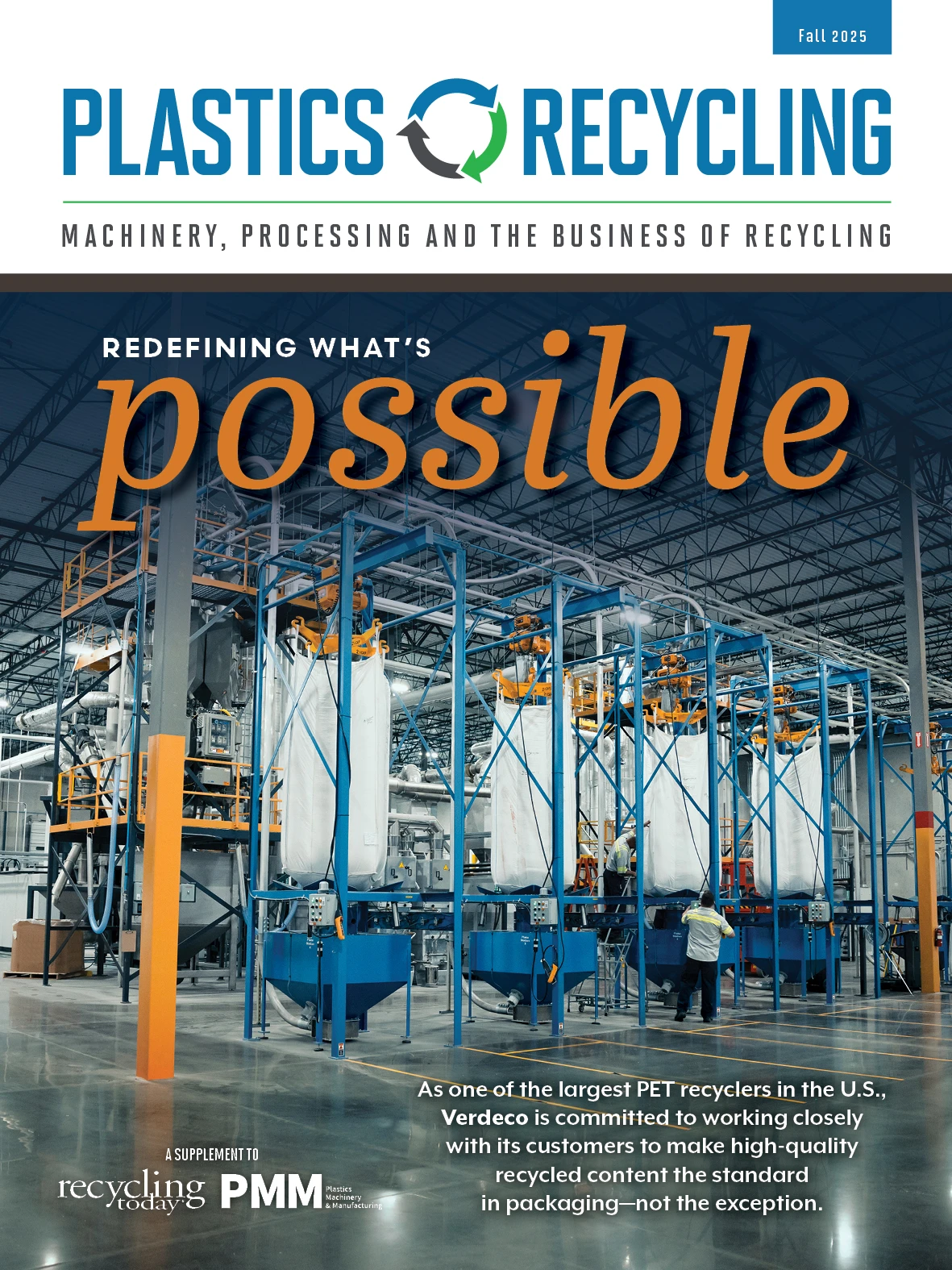
Explore the Fall 2025 Plastics Recycling Issue
Check out more from this issue and find your next story to read.
Latest from Recycling Today
- Fleetio launches AI capability to accelerate fleet maintenance approvals
- The Metals Agency receives approval for export credit insurance
- Recycle Ann Arbor extends drop-off station operating hours
- Sybilion seeks to help manufacturers confidently address volatility
- Rio Tinto, Prysmian partner on low-carbon aluminum solutions for data centers
- Unilever criticized for plastics approach
- USTR to study additional steel, aluminum tariffs
- Electrified Materials adds processing capacity