After three years of meetings, negotiations among roughly 180 countries for a treaty to end plastic pollution collapsed.
You could argue plastics recyclers are the biggest losers.
Plastic pollution is a dangerous problem that threatens everyone. Predictions on the amount of plastic that will enter the environment in the next 20 years should cause alarm because of the small amount of plastic currently being recycled.
Recyclers are the first critical step in achieving plastics circularity. A framework defining how the world would achieve plastics circularity could standardize collection rules, improve product design and create stable markets for recycled resin.
Our current patchwork system in the U.S. relies on local and state regulations—if they exist at all. Achieving plastics circularity in the country still is possible without a treaty, but it is going to take longer and might not be as effective.
“This is a solvable problem. The solutions are there,” says Kate Bailey, chief policy officer at the Association of Plastics Recyclers, Washington. “You have the politics, but in large part, the people who are coming to these events, the observers, accredited organizations, we know what to do. We know how to solve the problems.”
Bailey, who attended two of the six negotiating rounds organized by the United Nations, says she saw more consensus than disagreement despite disagreement dominating the headlines.
“There was actually a lot coming together,” she says. “The majority of the countries are supporting the same actions.”
Bailey says plastics recycling in the U.S. is “stalled out” and needs help, citing polyethylene terephthalate (PET) bottle recycling as an example.
“We know how to recycle every PET bottle on the market,” she says. “We collect 3 out of every 10 bottles across the country. We are stuck at 30 percent.”
How do we increase the 30 percent collection rate?
“It takes policy, it takes investment in infrastructure, it takes a variety of things,” Bailey continues. “This comes back to the recyclers being the losers.
“We are ready to take those plastic bottles and turn them back into new bottles or turn them into carpet. We all know it is good for the environment and the economy.”
At the end of the day, recyclers must be able to sell their recycled plastics.
“Until the world decides it is going to buy recycled content and move away from virgin, we are sort of stuck in a situation where we cannot scale,” Bailey says. “We need that buyer commitment.
“The funding’s there, the capital, the technology and the interest. We just need some of those larger market forces to align and give us the support we need.
“I think the most important message coming out of the entire UN treaty process is that the world is concerned. This is not a fleeting moment where the world got mad about the turtle with the straw through his nose and then we all moved on to something else. This is a fundamental shift in how we manage plastic waste. This is going to be something that evolves over the next several decades.”
Can plastics recyclers wait decades? That is the critical question.
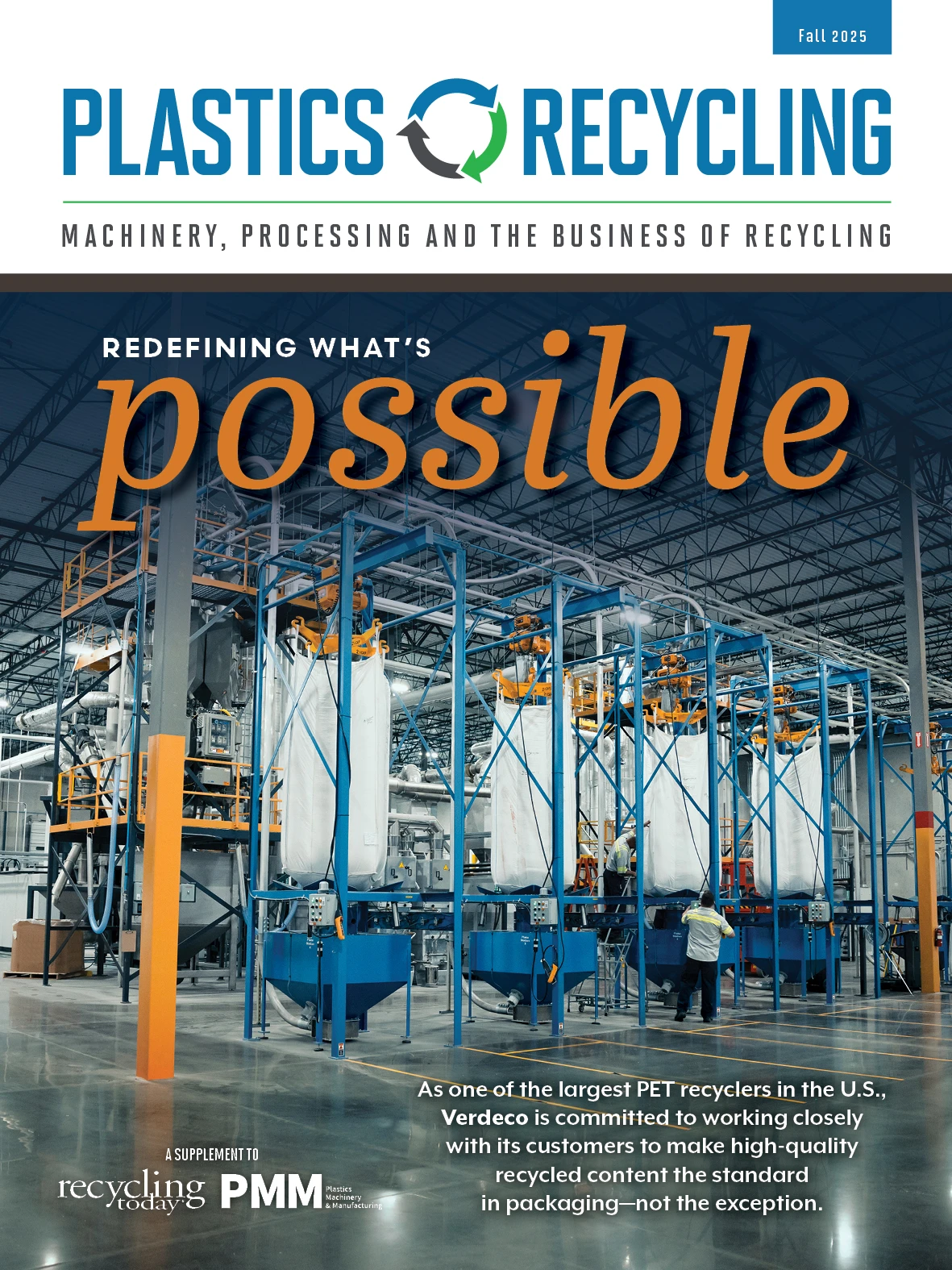
Explore the Fall 2025 Plastics Recycling Issue
Check out more from this issue and find your next story to read.
Latest from Recycling Today
- Fleetio launches AI capability to accelerate fleet maintenance approvals
- The Metals Agency receives approval for export credit insurance
- Recycle Ann Arbor extends drop-off station operating hours
- Sybilion seeks to help manufacturers confidently address volatility
- Rio Tinto, Prysmian partner on low-carbon aluminum solutions for data centers
- Unilever criticized for plastics approach
- USTR to study additional steel, aluminum tariffs
- Electrified Materials adds processing capacity