As recent reports have driven home, it’s not enough to collect plastic, sort it and bale it. The material requires demand. It needs somewhere to go. Otherwise, there’s no recycling taking place.
That lack of demand has helped damage recycled resin markets around the world, leading to plant closures and shifts in supply. This is coupled with a global oversupply of virgin resin and a steady flow of virgin and recycled imports—all more cheaply priced than their recycled counterparts.
A Feb. 12 webinar hosted by The Recycling Partnership highlighted the struggling recycled polyethylene terephthalate (rPET) market in the United States, and, notably, Association of Plastic Recyclers (APR) research showed a 65 percent increase in resin imports between 2022-2024.
Additionally, the latest “PET Recycling Report” published by the Middleton, Wisconsin-based National Association for PET Container Resources (NAPCOR) reported a U.S. PET bottle recycling rate of 30.2 percent in 2024, down from the 32.5 percent rate the year before.
PET recycling has long been regarded as a success story, with collection and recycling rates higher than any other plastic type. It’s struggles are not a good sign.
During the webinar, panelists suggested ways to stimulate demand for postconsumer resins (PCR) like PET. For example, Kate Eagles, program director at Washington-based APR, suggested policymakers enact PCR mandates for packaging producers and provide incentives to purchase material from domestic sources. She also pointed to long-term PCR contracts as a way to turn the tide.
“Contracts are the best indication of commitment that we have,” Eagles said. “We see that in MRF and hauler systems. There might be a [long-term] contract to service a community, and they’re important because they allow for equipment investments to run a recycling program. We have not seen that so much in plastic recycling.”
For states that have passed or are considering extended producer responsibility (EPR) legislation, the need for end markets for PCR amplifies. In July 2025, Oregon became the first state in the U.S. to launch its EPR program for packaging, and the development of responsible end markets for material continues to be a focus.
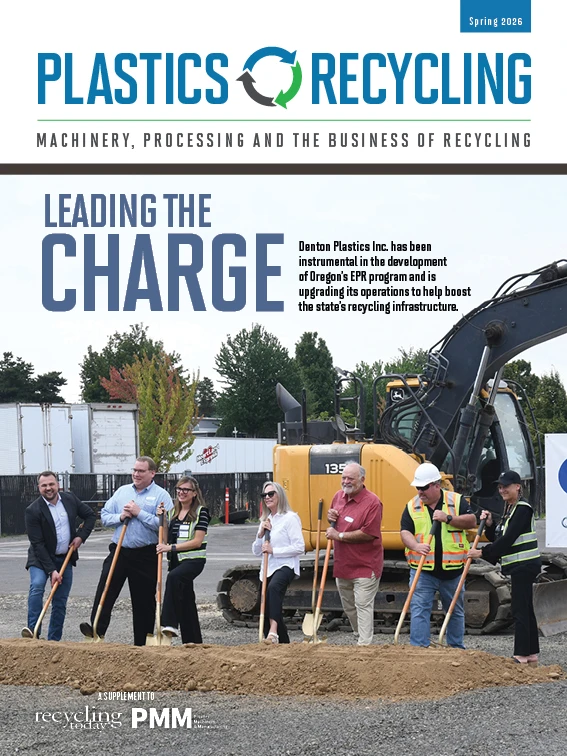
The subject of this issue’s cover story, Portland, Oregon-based Denton Plastics Inc., is one reclaimer leading the way. For polypropylene (PP), the company has added a wash line, flake sorter and an 18,000-square-foot storage facility that significantly will increase the amount of PP it can process.
Denton President Nicole Janssen is a plastics recycling stakeholder who, similarly to Eagles, has pushed for a PCR mandate in her state.
“If we want people like us to be here long-term to help manage this responsibility, we need to know that [packaging producers] have our backs as well,” she says.
With this issue, we also welcome back regular contributions from the Plastics Industry Association. The association’s Patrick Krieger also calls for minimum recycled content requirements, saying that policies that create demand complement those that create supply.
Explore the Spring 2026 Plastics Recycling Issue
Check out more from this issue and find your next story to read.
Latest from Recycling Today
- Presona links up with 2 UK firms
- eFactor3 enters into separation tech partnership
- NRC online event will review plastics survey results
- Novelis’ aluminum sheet receives recognition
- Jay Robinovitz to receive ReMA’s 2026 Lifetime Achievement Award
- Needs assessment surveys for Minnesota EPR law underway
- Poly Coated Paper Alliance adds new members
- Mitsubishi Logisnext Americas to rebrand as Logisnext Americas