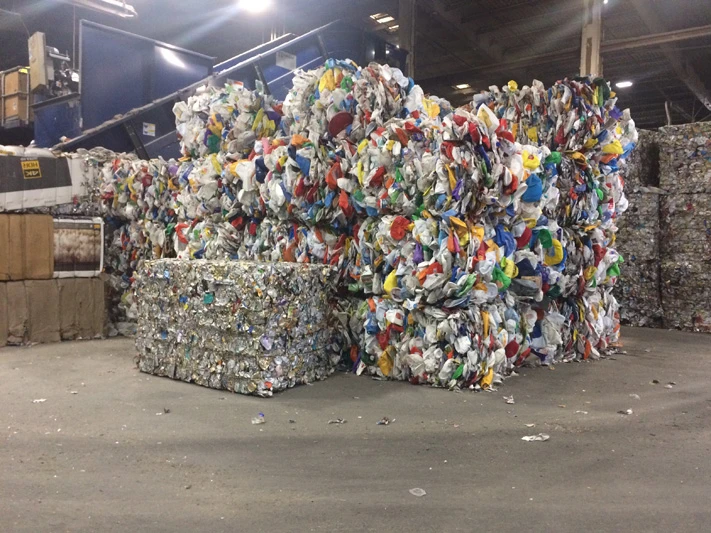
As world events and economic trends shape the outlook for ocean freight, recycled materials remain crucial cargo for shipping companies, according to speakers at the Paper and Plastics Recycling Conference in Chicago this past October.
Shipping and transportation experts gathered to speak at the session From A to B: The Outlook on Transportation, Oct. 16, moderated by Marc Ehrlich, CEO of Switzerland-based Vipa Group. Speakers included Allen Clifford, executive vice president at Mediterranean Shipping Co. (MSC), Geneva; Trond Prestroenning, CEO of Fr. Meyer’s Sohn (FMS) Americas, a business unit of Germany-based FMS; and Peter Tirschwell, vice president for maritime and trade at S&P Global Market Intelligence, New York.
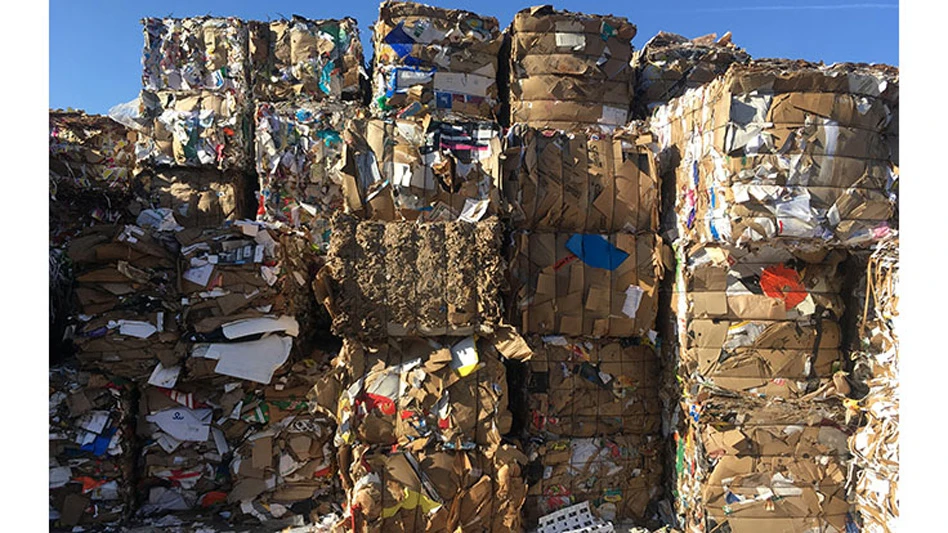
When the Ever Given container ship blocked the Suez Canal in 2021, 95 percent of the blocked vessels traveling from the U.S. to India were transporting recovered paper, Ehrlich said.
“A lot of people realized at that time that most of the products that we buy, that we consume, are transported by sea containers, and when this flow is interrupted, it’s a catastrophic situation,” he said. “We, as recovered paper shippers, are important to the shipping lines and … we are a byproduct of globalization, … because the more we import goods, the more we need to export packaging waste back into the countries that produce consumer goods.”
Industry changes

Tirschwell provided insights into the history of ocean freight, sharing that the industry is very different from how it used to be.
Originally built on the desire to provide timely, reliable service, ocean carriers soon realized this was unprofitable and, therefore, was unsustainable.
“To provide a reliable service, what do you have to do? You have to speed up the ship,” Tirschwell said. “Say that the ship runs into a storm or something like that, or gets delayed, but you still want to make your announced scheduled arrival. Well, you have to speed up. … So, fuel costs go way up, and you’re incurring costs that you’re not getting back in terms of the compensation coming back.”
The 2008 financial crisis saw this model dissolve as ocean carriers collectively decided to slow their fleets given the collapsing volumes, ultimately absorbing capacity and putting supply and demand into equilibrium.
In 2016, Hanjin Shipping, once the seventh-largest container carrier, filed for bankruptcy. Carriers responded by implementing “blank sailings,” which involve canceling scheduled voyages or skipping scheduled ports.
“They did that because [reliable service] was unprofitable,” he said. “Here the carriers were now learning how to take more and more proactive actions on their own behalf in ways that accrued to their benefit—slow steaming, idling, blank sailing—and accrue to the disadvantage of the customer.”
Tirschwell identified the COVID-19 pandemic as the next major event to add to the trend of ocean carriers withdrawing capacity from the market.
The pandemic slowed the supply chain as warehouses were backed up, truck chassis were being used to hold containers in warehouse parking lots and containers were piling up at the ports. This resulted in slower unloading time for ships, leading to congestion.
Tirschwell shared that despite these supply chain issues, ocean carriers were more profitable in 2020-2022 than they ever were, according to Sea Intelligence data.
“Now you have a situation where the carriers know that when capacity comes out of the market, that’s when they make money,” Tirschwell said.

Far from waste
As ocean carriers have become more profitable, Clifford reiterated the importance of recycled products as cargo.
“The fact of the matter is that we all deserve to earn a profit,” he said. “How much of a profit? That’s individual. … We made the decision that your products are very important to us, especially as our vessels continue to get larger.”
Clifford said tariffs could distort the competitive balance among global ports, leading some carriers to reduce or redirect service from the U.S. to avoid punitive costs and actions.
“When certain tariffs are agreed upon with India, with China [and] with Brazil, specifically, I think that you’ll see a great rush of cargo, not only from the United States … but to the United States,” he said.
Recovered packaging will make up much of the materials exported from the U.S., something Clifford referred to as base cargo. Carriers cannot begin filling a 25,000 TEU, or 20-foot-equivalent-unit, container ship from zero at every port, he said, so they rely on materials like recovered packaging to provide a base for potentially higher revenue cargo to be shipped alongside.
“We may, at times, transship your cargo because I may take other cargoes on a direct basis at times, but I will always take your cargo,” Clifford said. “Your cargo is very important to us. Recyclables, wastepaper, these cargoes … are important not only to an MSC but to all ocean carriers. … Don’t let anybody tell you that your product is not important on an international basis.”
Explore the December 2025 Issue
Check out more from this issue and find your next story to read.
Latest from Recycling Today
- Metallum offers gateway to Europe
- Stena Recycling invests to handle EV batteries
- Amcor earns UN certification for industrial containers with PCR
- Oregon lawmakers pass battery recycling bill
- Volvo says loader updates improve efficiency
- One and One focuses on PCB recycling
- Indicators point to hiccups in steel demand momentum
- WM opens upgraded recycling facility in Southern California