CURBSIDE ASEPTIC PACKAGING EFFORTS EXPAND IN THE U.S.
Aseptic packaging is now part of curbside collection programs that reach 7 million households in the United States, according to the Aseptic Packaging Council, Washington. The first program that accepted aseptic packages such as milk cartons and juice boxes began in 1991.
Recently, Hartford, Conn., added aseptic packages to its curbside collection program, and all communities in the state of Rhode Island now have the opportunity to add aseptic packages to their curbside collection efforts due to a Waste Management Recycle America material recovery facility in the state that has added processing equipment to handle the material. Currently, eight U.S. mills accept aseptic packaging, and three brokers handle it.
WORLD’S LARGEST PLASTIC SHOW TO BE HELD NEXT YEAR
The triennial National Plastics Exposition will be held next year from June 16 to 20 at McCormick Place in Chicago. The event is the world’s largest plastic exposition, attracting about 75,000 attendees from the United States and more than 90 other countries, according to the Society of the Plastics Industry Inc., Washington, which sponsors the event.
The show is expected to showcase about 1,500 exhibitors. There will also be 20 conference sessions, including presentations on recycling, molding, composites, machinery, packaging, controls, thermo-forming, and more.
For more information about the show, call (202) 333-7966, or
e-mail Ed Segal at edsegal@aol.com .
PAPER MARKETS REMAIN DEPRESSED
Oversupply and weak market conditions continue in recovered fiber markets, reported Steve Vento of William Goodman & Sons Inc., Sunrise, Fla., at the recent Bureau of International Recycling meeting in Brussels. "There do not appear to be any indications of an upturn in the market even into the first quarter of 1997," said Vento.
Domestically, the demand for low grades such as mixed paper, board mill news and deinked news remains flat. Old corrugated containers remain in strong demand due to the startup of new paper machines and increased capacity of existing mills. However, newsprint production is very flat and is not expected to improve until late second quarter or early third quarter of 1997.
The printing and writing sector remains flat while tissue production is strong, Vento said. Some deinking mills are again suffering due to lack of demand for their product while others struggle to find the right quality of sorted office paper to consume. Pulp substitutes are also firm, with steady orders from mills.
COLLEGES PIONEER POLYSTYRENE RECYCLING
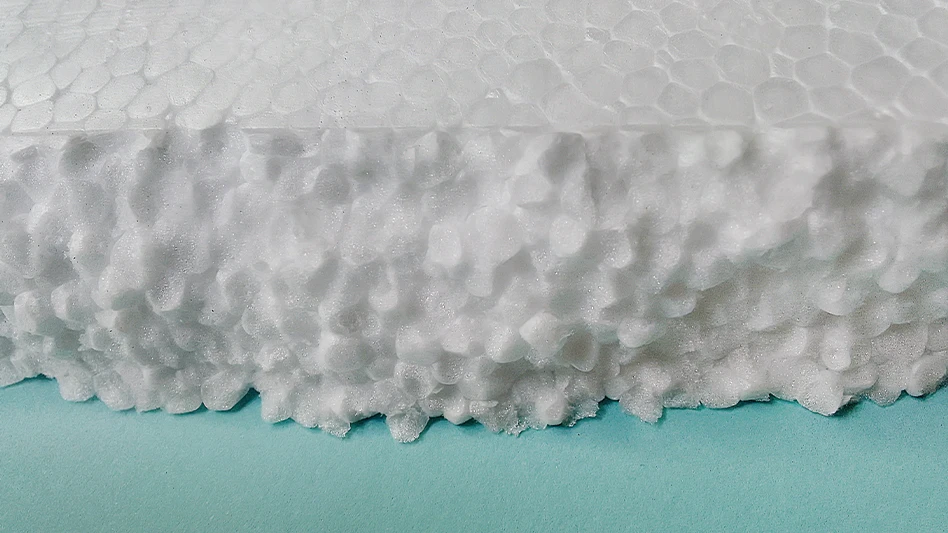
In a pilot program involving about 10 New England colleges, students are tossing their polystyrene materials into a separate bin, food-service supplier Hallsmith-SYSCO, Norwood, Mass., is collecting the product, and Forrest Brokerage, North Reading, Mass., is returning baled PS to manufacturers.
"It’s a win-win story," says Louis Tarentino, director of buildings and grounds for Hallsmith-SYSCO. "We sell more product, our customers save the cost of disposal of a useful material, and the manufacturers get their product back for reuse."
There’s also a fourth possible "win" in Tarentino’s equation – the manufacturers supply participating colleges a baler, and once the dollar value of the baler has been met, the savings go back to the school in a monthly check. According to Holy Cross College, Worcester, Mass., longest in the program and currently generating 6,000 to 10,000 pounds of polystyrene per week, "the check’s in the mail."
CRUMB RUBBER USED IN ATHLETIC FIELD
About 90 tons of crumb rubber from 11,000 scrap tires were recently used as a top dressing for a football field at a new stadium for East Central High School in Tulsa, Okla. The crumb rubber was applied under the trademark name Crown III which is sold by JaiTire, Denver, and was patented by researchers at Michigan State University. The crumb rubber reduces soil compaction, extends the grass growing season and makes the turf softer, thus helping to reduce injuries, according to JaiTire officials. To date, more than 300 turf sites in North America have had Crown III applied.
GEORGIA-PACIFIC EXPANDS TISSUE MILL
Georgia-Pacific Corp. has announced plans to spend $150 million over a two-year period to expand its tissue production capacities in Crossett, Ark. The company says the expansion, to be completed in 1998, will increase tissue manufacturing capacity about 10 percent. The expansion will include a new machine, two converting lines, more repulping capacity and associated facilities.

Explore the December 1996 Issue
Check out more from this issue and find your next story to read.
Latest from Recycling Today
- Vecoplan to present modular solutions at IFAT 2026
- Terex Ecotec appoints Bradley Equipment as Texas distributor
- Greenwave raises revenue but loses money in Q2 2025
- Recycled steel prices hold steady
- EY says India’s need for scrap imports will continue
- Coming full circle
- Amcor, DCM introduce fertilizer packaging with 35 percent recycled content
- Comstock Metals gets closer to commissioning commercial-scale solar panel recycling facility