Paper
More packaging investments, site closures announced
Several paper packaging companies have announced investments in new facilities recently, while others have revealed plans for closures.
Pratt Industries has announced plans for a new manufacturing facility in Rock Hill, South Carolina, where it will produce its recycled packaging.
The Conyers, Georgia-based company is investing $92.5 million in a site at 2087 Williams Industrial Blvd., where Pratt also has a recycling facility.
“We are excited to expand our operations in ... South Carolina and the mid-Atlantic region,” Pratt Industries Global Executive Chairman Anthony Pratt says. “Our new facility supports our continued commitment to invest in recycling, clean energy infrastructure and American manufacturing jobs.”
South Carolina’s Coordinating Council for Economic Development approved job development credits related to the project. The council also awarded a $400,000 set-aside grant to York County to assist with the costs of building improvements.
“[Pratt’s] ongoing success underscores all that can be accomplished with a strong commitment to sustainability and circularity,” Commerce Secretary Harry M. Lightsey III says. “We are proud the company continues growing in South Carolina and congratulate Pratt Industries on its newest manufacturing facility in York County.”
Additionally, Smurfit Westrock is planning to invest approximately $19.3 million to expand its corrugated packaging manufacturing facility in Saltillo, Mississippi.
The Dublin-based company, with North American headquarters in Atlanta, is adding new converting equipment to increase efficiency and allow larger-format packaging production.
The project is expected to be completed by October 2026 and upon completion, the upgrade is expected to improve the facility’s output by about 50 percent.
“The decision by the Smurfit Westrock team to expand in Saltillo reinforces what so many already know—Mississippi is a manufacturing powerhouse,” Mississippi Gov. Tate Reeves says. “As long as companies like Smurfit Westrock continue to rely on Mississippi to get the job done right, we will continue showing the world what we can do.”
The Mississippi Development Authority is aiding the project through the Mississippi Flexible Tax Incentive, or MFLEX, program. Lee County also is assisting with the project.
“Smurfit Westrock is committed to optimizing the performance and value of its manufacturing operations,” Smurfit Westrock North America President and CEO Laurent Sellier says. “The expansion of the Saltillo facility demonstrates our ongoing collaboration with development partners in Mississippi, increases capacity and growth within our system and supports the communities where we live and work.”
Meanwhile, Packaging Corp. of America (PCA) is the latest to announce a facility closure, with the Lake Forest, Illinois-based company set to shut down a corrugated packaging plant in Salisbury, North Carolina.
PCA filed a Worker Adjustment and Retraining Notification, or WARN notice, with the state Oct. 3. According to the filing, 108 employees will be laid off and the facility permanently closed by Dec. 19.
“This represented a difficult business decision,” PCA Deputy General Counsel Mark Romaniuk writes in the WARN notice. “We regret the impact the permanent plant closure will have on our valued employees and the community at large.”
PCA lists its Salisbury site as a full-line corrugated packaging plant. Including Salisbury, the company has 51 full-line packaging facilities in the United States and only one other in North Carolina.
The move comes a little over a month after PCA finalized it $1.8 billion purchase of the containerboard business of Delaware, Ohio-based packaging company Greif Inc., and the company previously had not followed the trend of paper packaging facility closures.
However, in this year’s second quarter, PCA reported “cautious ordering patterns” from its corrugated products customers as well as a decrease in export containerboard sales.

Plastics
Study says Republic rPET flake has reduced carbon footprint
Waste and recycling services company Republic Services Inc., Phoenix, claims a recently completed product carbon footprint (PCF) study confirms that recycled polyethylene terephthalate (rPET) flake produced at its Las Vegas Polymer Center for use in packaging has a lower carbon footprint than representative rPET or virgin PET in the U.S. market.
Additionally, the company says the study confirms the material’s potential to help customers decarbonize supply chains and reduce Scope 3 emissions.
Republic says, on average, the global warming potential of its bottle-grade, clear rPET flake produced in Las Vegas is 54 percent lower than the rPET flake alternatives evaluated and 82 percent lower than virgin PET. These finding are included in an independent cradle-to-gate PCF study conducted at the Polymer Center during the first seven months of 2024, which included comparisons to representative rPET and virgin PE produced in the U.S. and material imported from Asia.
“We developed our Polymer Centers to enable bottle-to-bottle circularity and help meet increasing demand for high-quality recycled plastics,” says Pete Keller, Republic’s vice president of recycling and sustainability. “The rPET flake we produce is not only helping customers meet goals and requirements for recycled content in their packaging but also helping reduce their environmental impact.”
Republic makes an average of 5 million recycling and waste pickups daily and operates 75 recycling facilities across North America. Recovered plastics from these facilities are delivered to a Polymer Center for secondary processing, and PET is shredded and washed to produce bottle-grade, clear rPET flake ready to be remanufactured into new beverage bottles.
The company claims the lower carbon footprint of its rPET is primarily due to more effective energy use at the Las Vegas Polymer Center.
The facility uses a patented equipment line the company says uses less electricity and thermal energy per kilogram of flake than other mechanical recycling processes, for example. Also, processing is shared with other key materials recovered, and the regional utility grid has a lower carbon footprint than either the average U.S. grid or the Asian market’s grid mix considered in the PCF study.
Republic operates Polymer Centers in Las Vegas and Indianapolis, with a third facility under construction in Allentown, Pennsylvania. The company says each facility can produce approximately 120 million pounds of bottle-grade recycled plastics annually.
In August, Keller told Recycling Today the 10-acre Allentown site would begin construction in late October, with the potential for equipment installation to begin in April 2026. The facility is expected to be operational by the end of next year.
“Early indications are that demand for our rPET flake will be strong,” he said in August. “With our existing Las Vegas and Indianapolis facilities, Allentown will help us continue to build out our national hub-and-spoke Polymer Center network.”
Each Polymer Center mechanically processes plastics collected from homes and businesses, including PET, high- density polyethylene (HDPE) and polypropylene (PP). While PET is processed to make rPET flake for use in new bottles, HDPE and PP are sorted by color and type and sent to Blue Polymers, a joint venture between Republic and Ravago, a Luxembourg-based plastic recycling and distribution company, to be compounded, blended and pelletized, creating custom drop-in products for customers.

Metals
Aurubis producing copper in Georgia
The melt shop at the Aurubis Richmond facility in Augusta, Georgia, a business unit of German metals producer Aurubis AG, has started producing recycled-content nonferrous metals.
Aurubis says the new site is the first United States multimetal recycling plant, recovering strategic metals for U.S. energy infrastructure and the defense industry.
“With Aurubis Richmond, we are the frontrunner in multimetal recycling and processing in the U.S.—a position that we already hold in Europe,” Aurubis CEO Toralf Haag says.
“We will continue expanding our wide expertise in producing key strategic raw materials here. With the high availability of recycling material and good local conditions, the American market offers Aurubis appealing prospects that we will continue to consider closely in the future as well.”
The company says demand for strategic metals such as copper is rising steadily worldwide and that U.S. industry alone currently needs about 1.8 million tons of copper per year.
Aurubis says the U.S. currently imports about half of the copper it consumes. Multimetal recycling can close this gap quickly, according to the company, referring in part to its $800 million secondary smelter in Georgia.
The Aurubis Richmond plant has been designed to process up to 180,000 tons of end-of-life materials annually, including printed circuit boards and copper wire and cable, recovering a variety of nonferrous metals.
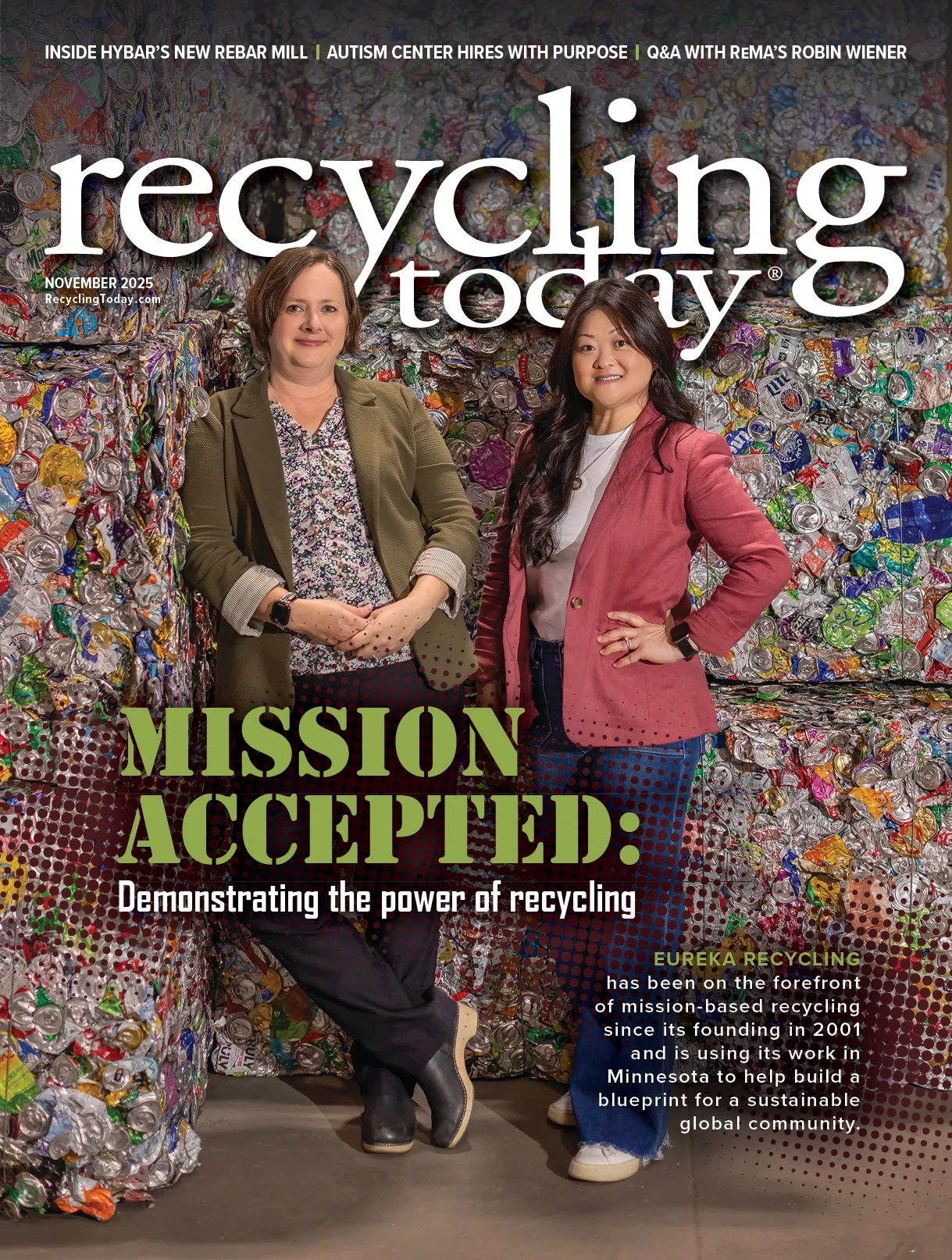
Explore the November 2025 Issue
Check out more from this issue and find your next story to read.
Latest from Recycling Today
- Fleetio launches AI capability to accelerate fleet maintenance approvals
- The Metals Agency receives approval for export credit insurance
- Recycle Ann Arbor extends drop-off station operating hours
- Sybilion seeks to help manufacturers confidently address volatility
- Rio Tinto, Prysmian partner on low-carbon aluminum solutions for data centers
- Unilever criticized for plastics approach
- USTR to study additional steel, aluminum tariffs
- Electrified Materials adds processing capacity