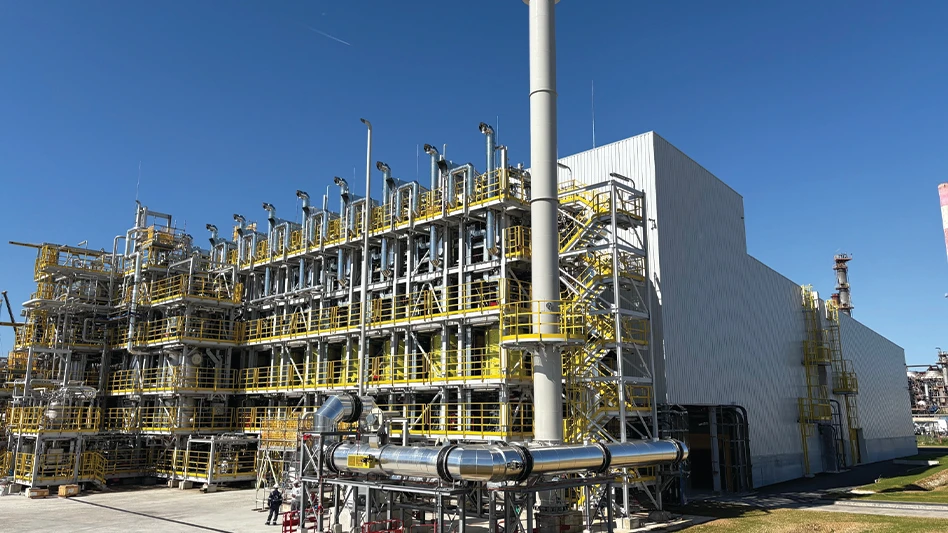
Whether a material recovery facility (MRF) is built new or retrofitted, operators and equipment suppliers share the goal of a smooth and efficient commissioning process.
During back-to-back sessions at the 2025 MRF Operations Forum in Chicago last October, panels that included operators and suppliers discussed how to ensure successful commissioning and best practices learned through their experiences. Both sessions were moderated by Nat Egosi, president of Melville, New York-based RRT Design & Construction.
Identifying a timeline
During both sessions, panelists considered the amount of time it takes for new MRF systems to meet expectations and the importance of working together throughout that process.
In the view of Brent Shows, area recycling director at Miami Beach, Florida-based GFL Environmental Inc., it typically can take a MRF 90 days after powering on a new system to meet 80-90 percent of its expected production, though he admitted it also could take longer.
“Is [90 days] always the case? No,” Shows said. “There are a lot of factors that influence where you’re at. By 90 days, you’re pretty locked in, and staff is continuing to train.”
Shows said that after six months, it could be determined that a MRF needs to bring a supplier back in to help provide more training or to reach out for corporate support, but emphasis should be placed on that initial 90 days.
“You assess the shortcomings and make repairs,” he said. “By six months in, you’re pretty close [to meeting expectations].”
Ron Stearns, senior manager of infrastructure design for Republic Services Inc., headquartered in Phoenix, pointed out that the process of fine-tuning and commissioning after startup is not linear.
“It might take you up to six months to get it perfected, but you should be making money by 10 days,” Stearns said.
Eric McGaughey, business optimization director, innovation, at Houston-based WM, said six months is a realistic timeframe to be very close to meeting performance expectations, though different factors could come into play.
“Quite often, like during [the COVID-19 pandemic], you’re ordering these systems two, three years in advance, but we’re also seeing the material composition change,” he said. “That changes the way a system operates and adds more time to understand it. It’s more than just setting the plant up.”
Representing the suppliers’ point of view, Benjamin Eule, director of Stadler U.K. and head of commissioning at Stadler Anlagenbau GmbH in Germany, agreed with the timeline of three-to-six months but noted that systems take longer to learn.
“There’s a post period after the commissioning, a support period, where you could go three months to six months to nine months, whatever you can afford, so we can continue to work on [the system] and the operation doesn’t fall off a cliff,” Eule said.

Walk, don’t run
The panel of suppliers noted that getting a MRF to run properly after startup requires a measured approach.
“Initially, we try to get the plant to produce something,” Eule said. “We operate, slow, operate safe [and] then ramp it up. We give the operator enough time and give my commissioning staff enough time because if we go too quickly, we hinder our chances at success.”
Consistent communication between the systems integrator and plant operator is key to successful commissioning, according to David Marcoux, project commissioning coordinator at Plessisville, Quebec-based equipment manufacturer Machinex.
“You have to be involved with the client in the decisions process and then let them know where you’re at in your commissioning,” he said, suggesting a 15-minute morning meeting can “align the mission” and inform all parties on what targets they’re trying to hit for the day.
“A lot of it is done by talking to each other and keeping each other informed on how and where it’s going.”
Josh Robbins, startup manager at Van Dyk Recycling Solutions, Norwalk, Connecticut, added that it’s important to go over training and documentation consistently with operators to ensure success.
Mark Henke, director of process improvement at San Diego-based CP Group, said his company gets involved in a peer review up front so it doesn’t walk into a commissioning project blind.
“We know what the flow and design is, so we can make recommendations,” he said. “We go into it with our expectations, and communication is key. Where is that leap of technology point? That will determine whether this is going to be a three-to-six month endeavor. Then you start to cut the ties. You give [the operator] some time to see where they’re at, then we’re a phone call away.”

Getting up to speed
When a MRF’s staff is tasked with learning new equipment or working in a new market as inbound tonnage continues to change, training is paramount, according to McGaughey.
“When you work with a new site, even if [the staff] has some sort of manufacturing experience, it’s about getting them to understand you’re making a widget out of an ever-changing inbound [material stream], and it can be hard to get them to understand,” he said.
He emphasized walking staff through each process to ensure they understand the details when it comes to separating material by size or shape or optically sorting material, for example.
Stearns suggested bringing maintenance staff into the MRF before system installation is finished so they can learn about equipment as it is being installed.
In addition to the challenges of getting staff familiar with new equipment, Shows said, is keeping people around through a retrofit, which can be difficult.
“You want to keep your seasoned people on staff,” he said. “Along with corporate support, you want to identify a plant that’s similar to what we’re moving to, get them there for a few weeks to work with them and help give them pointers along the way so they can learn what to do and develop a comfort level.”
McGaughey noted that the current job market is a challenging one, and a company might bring in new employees, train them for weeks or months and then they decide to move on to another industry or simply stop showing up.
To that end, Shows added, “You get [new employees] in the door and show them what they’re going to be doing before they start, but even that doesn’t prepare you for what you’ll actually be doing. You’ll find out pretty quickly if they’re going to stay on or not.”
Explore the February 2026 Issue
Check out more from this issue and find your next story to read.
Latest from Recycling Today
- SA Recycling votes to remove United Steelworkers
- England's Environment Agency extension provides stability for metal shredding operators
- Schupan names new chief financial officer
- NAW looks ahead to July hearing in Oregon
- Recycle Coach partners with Bartec Municipal Technologies
- EPA proposes abandoned tire cleanup plan with focus on energy recovery
- BIR welcomes new policy officer for trade & environment
- Global Recycling Foundation recognizes Recycling Heroes