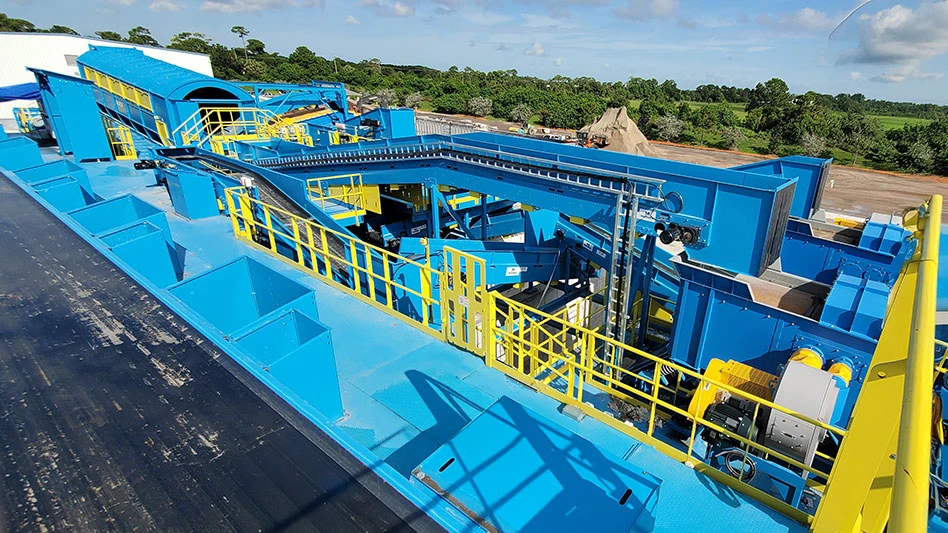
Designing and building a material recovery facility (MRF) is no small task. From tight project timelines and building restrictions to the coordination of multiple trades, the path from concept to commissioning is lined with obstacles. Add to that the financial weight of downtime, and it becomes clear why execution matters as much as technology.
Machinex, a MRF manufacturer and integrator based in Plessisville, Quebec, has built a reputation on meeting those challenges. Known for manufacturing its own sorting technologies, Machinex emphasizes the importance of project management, installation sequencing and startup efficiency as much as the equipment itself.
The industry challenge
Modern MRFs face numerous pressures. Facilities often are designed within existing industrial footprints that were never intended for recycling, forcing designers to fit advanced systems into tight and sometimes outdated buildings. Installation requires careful sequencing of conveyors, screens, optical sorters, robotics and balers while coordinating with customer and construction crews, fire safety inspectors and more.
At the same time, extended producer responsibility (EPR) policies and evolving material streams are raising the bar on throughput and purity, making it essential that new systems immediately perform to market expectations.
“The challenge is not just engineering equipment, it’s engineering the entire project,” says Sébastien Roy, project director at Machinex. “From design to installation to startup, every detail matters.”
The Casella example
One example of this approach is the retrofit of Casella Waste Systems’ Charlestown MRF in Boston. Despite the complexity of the site and the scale of the system, the project was completed on schedule.
Within the first week of operation, the new system already was processing material at market-ready purity levels—a reflection of the planning and precision behind the installation.
“When choosing the proper vendor, there is so much more than engineering equipment,” Casella CEO John Casella says. “From selecting the right technology, working through design and installation and then execution, the collaboration between the Machinex and Casella teams was near flawless, especially the follow-through to ensure we achieved all our goals.”
Communication and values

Along with the technology, both companies point to shared values and clear communication as the keys to success. Machinex believes the best solutions come not from imposing a design, but from developing it with the operator.
“Communication and the customer relationship is truly the key, and this is where Machinex shines,” Roy says. “I think the best solutions are the ones you develop with your customers.”
A formula for success
The Casella retrofit illustrates that overcoming MRF project challenges requires more than machines. It requires a supplier willing to plan deeply, coordinate across trades, adapt to site restrictions and start up systems that hit performance targets from day one.
For Machinex, that formula—combining equipment expertise with customer collaboration—has become its hallmark.
Explore the October 2025 Issue
Check out more from this issue and find your next story to read.
Latest from Recycling Today
- Greenwave raises revenue but loses money in Q2 2025
- Recycled steel prices hold steady
- EY says India’s need for scrap imports will continue
- Coming full circle
- Amcor, DCM introduce fertilizer packaging with 35 percent recycled content
- Comstock Metals gets closer to commissioning commercial-scale solar panel recycling facility
- Washington selects Circular Action Alliance as PRO
- Smurfit Westrock expands in Latin America