As a circular economy pioneer for decades, Goodwill Industries, Ontario Great Lakes (OGL), based in London, Ontario, is committed to environmental stewardship by repurposing millions of pounds of goods each year in partnership with the communities it serves.
For fiscal year 2024, Goodwill Industries OGL collected more than 69 million pounds of donated goods, with just over 45 million pounds sold for reuse and another 14 million pounds to recycling, repurposing approximately 86 percent of all goods received.
With its foundation built on reusing and repurposing, Goodwill has set a goal for zero waste to landfill. It currently has an aftermarket solution for textiles that involves repurposing material into durable rags and forming partnerships with brands, recyclers and innovators to create solutions for hard-to-recycle fabrics.
However, plastic waste still was an issue.
Goodwill wanted to find a solution for what to do with broken, contaminated or otherwise unrecyclable plastics.
Every industry is faced with challenges, but recycling, in particular, faces additional barriers with high contamination rates and difficult-to-recycle material. While polyethylene terephthalate (PET) has a more established recovery stream, items made from other rigid plastics can be difficult to recycle due to their bulky size, mixed materials and lack of downstream markets.

“Those plastics being a lower-value commodity means there aren’t a lot of recyclers that will take a mixture of the plastics,” says John Quigley, circularity and sustainability specialist at Goodwill. “These plastics were then sent to a landfill. Since there wasn’t an aftermarket solution in place, we needed to create one.”
To come up with that solution, Goodwill turned to Rotogran International Inc., a Bolton, Ontario-based size reduction equipment manufacturer focused on the plastics and recycling industry.
Custom granulator
Rotogran has been serving the plastics and recycling industries for more than four decades, with a reputation for engineering durability and tailoring solutions to meet customer demand.
Mike Cyr, president of Rotogran, says the company has seen and been a part of all the major developments in size reduction throughout the years.
“This experience enables us to understand the needs of our clients and produce cutting-edge equipment that exceeds the requirements of the most demanding applications,” he says. “Customization is very important, especially when it comes to recycling and handling a wide range of scrap material.”
Rather than offering an off-the-shelf product, Rotogran collaborated closely with Goodwill to custom-design a system capable of handling the inconsistent, hard-to-recycle material. The solution included a granulator, feed conveyor and evacuation system, all integrated into a line expected to divert more than 600,000 pounds of plastic per year from landfill.
Goodwill is using the Rotogran WO-2236 75-horsepower granulator. The machine features an open offset tangential feed cutting chamber for large parts. The granulator also includes twin solid steel flywheels and solid knife seats to maintain cutting inertia with less horsepower. The custom tallboy-style feed hopper allows for a large variety of plastic parts to drop directly into the cutting chamber.
Rotogran has carved out a niche as both a manufacturer and a problem solver. By customizing systems to the customer’s needs, Rotogran is enabling organizations like Goodwill to create new opportunities for waste diversion.
“Rotogran put together a plan to custom-build a granulator based on our specific needs,” Quigley says. “The granulator is integral to this circular solution, which will repurpose these plastics, keeping them in use.”
Partnering on sustainability
Goodwill values its community partnerships and believes its collaboration with Rotogran is a testament to this.
The organization says it preferred to partner with a local recycling machine manufacturer, which factored into the decision to work with Rotogran. However, Quigley says what also set Rotogran apart were the positive reviews of its equipment and recommendations from other industry partners.
He adds that Rotogran is highly respected within the industry and that, since partnering, its customer service has been second to none.
“It’s incredibly personal with their eagerness to check in,” Quigley says. “They are fantastic at communicating, troubleshooting and just in general [at following] up to see how things are going. They have an incredible response to help find solutions.”
Goodwill Industries OGL also partnered with GreenWell Plastics, a Barrie, Ontario-based remanufacturer that is converting Goodwill’s granulated plastic into lumber, outdoor furniture and more.
GreenWell says its focus is on displacing as much plastic waste from landfill as possible. The company says it has spent years developing its formula to ensure its lumber is produced with a consistent color while using difficult-to-recycle plastic material otherwise destined for landfill.
Plastic lumber is made entirely from plastic, mostly high-density polyethylene, that looks and feels similar to wood. Now, instead of disposing of unwanted plastic, Goodwill grinds the material down and sends it directly to GreenWell. The company then uses that material in its manufacturing process to create durable, long-lasting plastic lumber.
Given the immediate impact and potential to help address plastic waste in other regions, Goodwill plans to replicate this initiative, researching working with Rotogran and the business community across Ontario.
“We’re proud to work with Goodwill Industries, Ontario Great Lakes on their sustainability efforts,” Cyr says. “This is a game-changing initiative that will divert plastics from landfill and help contribute to the circular economy in an impactful and meaningful way right here in Ontario.”
As recycling challenges grow more complex, collaborations offer a successful path forward. By combining Goodwill’s community reach, Rotogran’s engineering expertise and GreenWell’s manufacturing solution, a once-stubborn waste stream is being transformed into opportunity.
Goodwill looks forward to building more partnerships with businesses looking to offset their plastic waste and local remanufacturers making sustainable products.
“There is a lot of capacity to expand,” Quigley says. “We’re looking forward to seeing how this sustainability initiative continues to evolve and grow.”
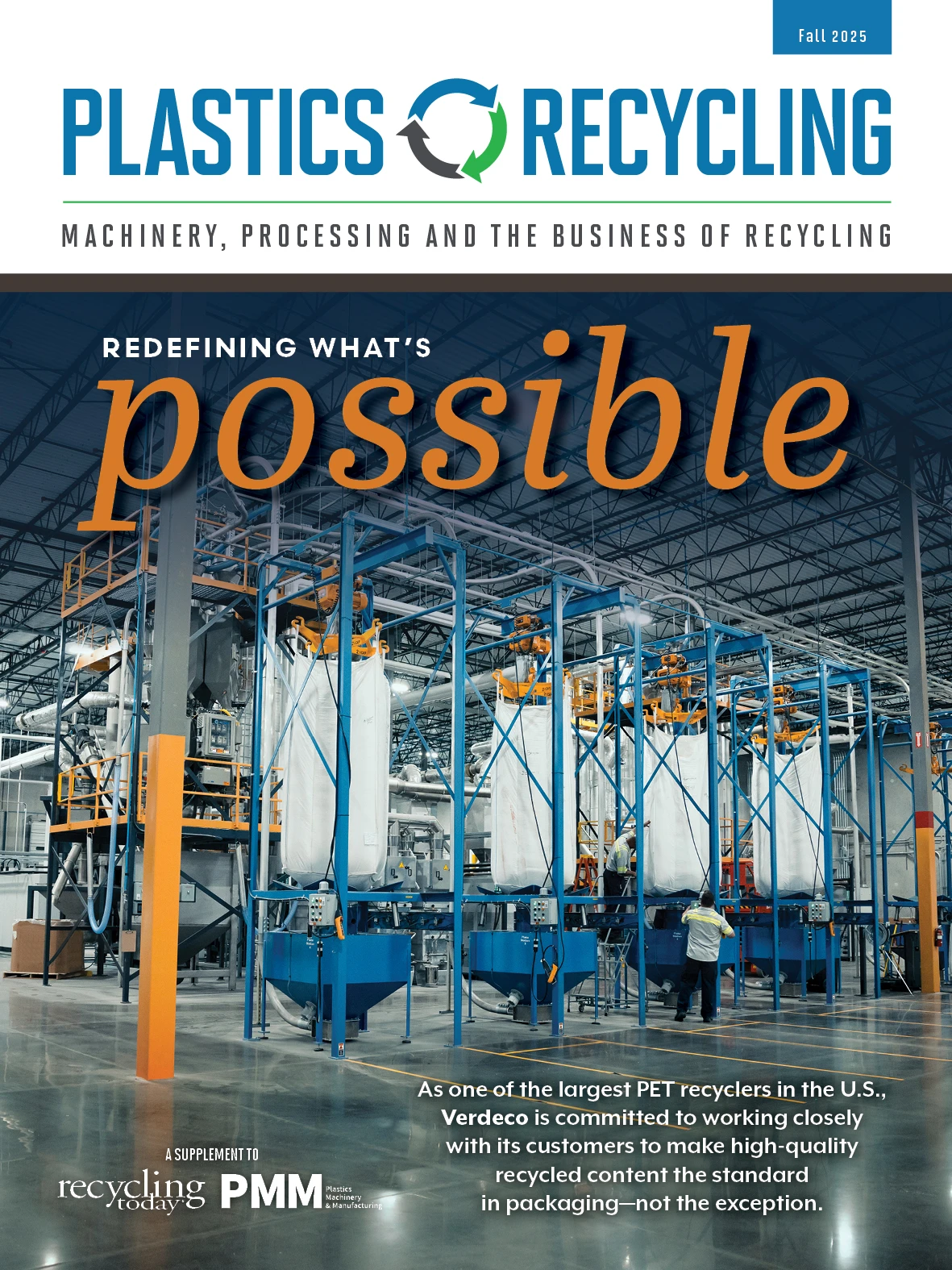
Explore the Fall 2025 Plastics Recycling Issue
Check out more from this issue and find your next story to read.
Latest from Recycling Today
- Fleetio launches AI capability to accelerate fleet maintenance approvals
- The Metals Agency receives approval for export credit insurance
- Recycle Ann Arbor extends drop-off station operating hours
- Sybilion seeks to help manufacturers confidently address volatility
- Rio Tinto, Prysmian partner on low-carbon aluminum solutions for data centers
- Unilever criticized for plastics approach
- USTR to study additional steel, aluminum tariffs
- Electrified Materials adds processing capacity