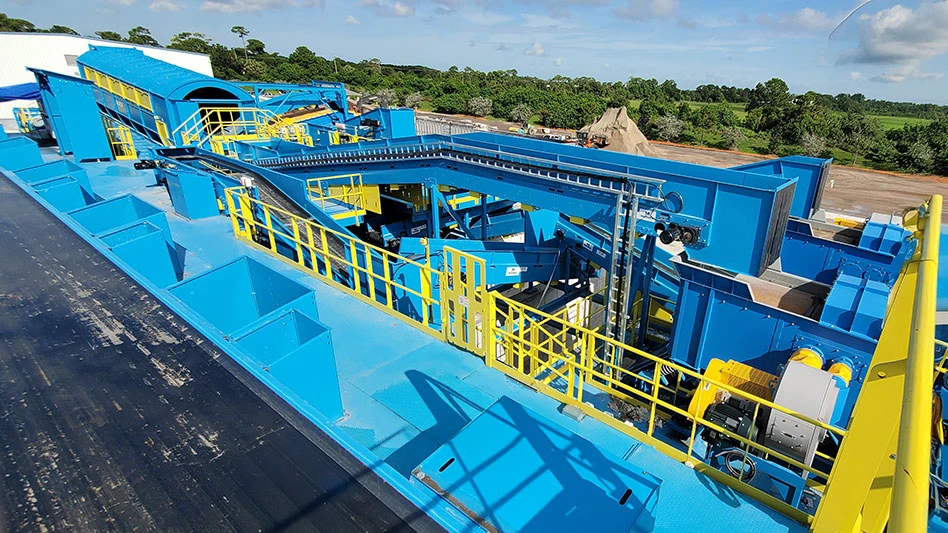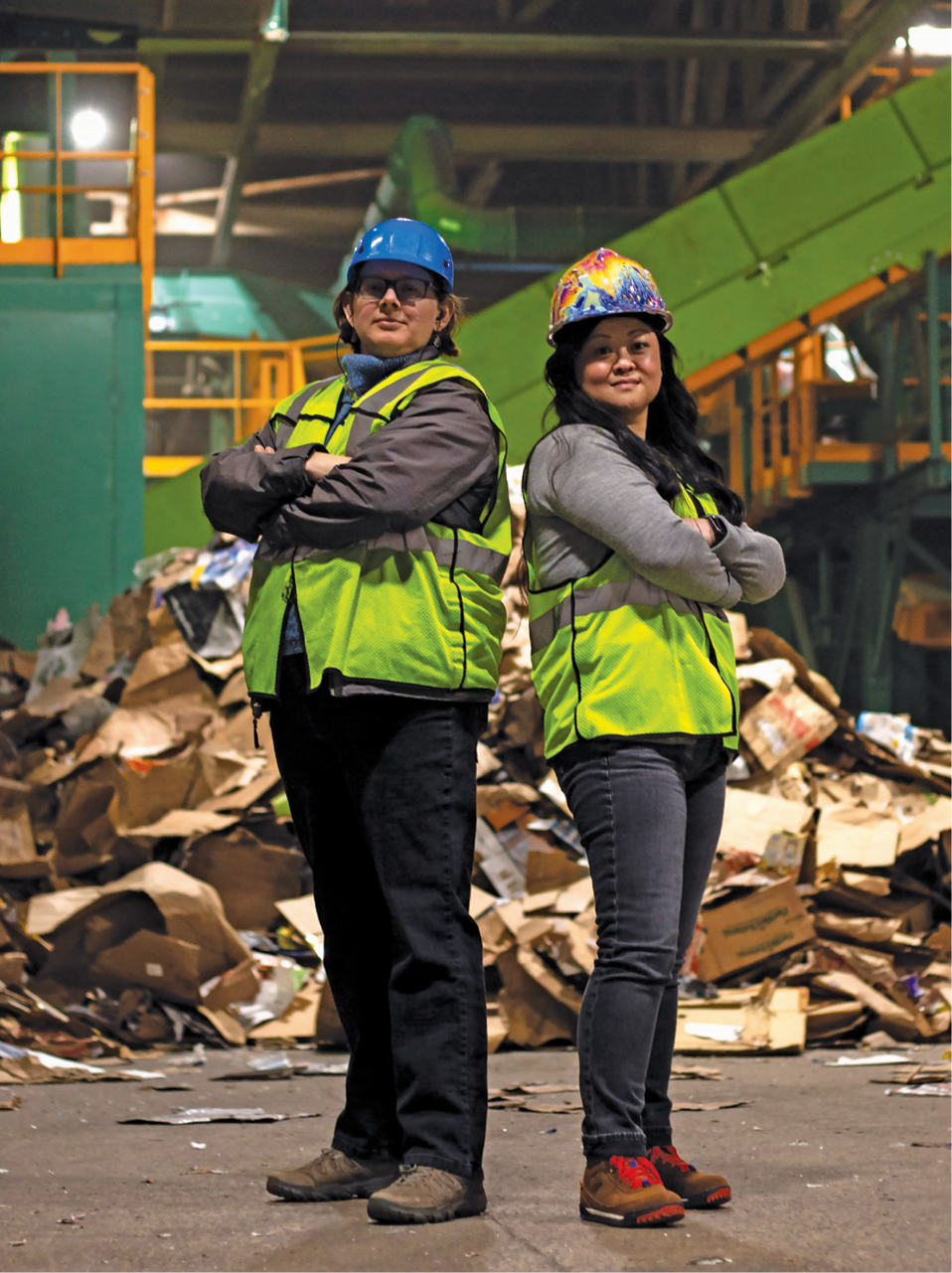
Eureka Recycling’s material recovery facility (MRF) in its hometown of Minneapolis celebrated 20 years in business in April, and to mark the occasion, the company relaunched the newly upgraded MRF following a $12 million investment in sorting and processing equipment.
According to Eureka, which processes approximately 100,000 tons of recyclables annually, the enhanced MRF promises to “substantially” increase processing capacity and efficiency.
“This upgrade represents more than just new equipment—it’s a recommitment to the communities we serve and to the zero-waste mission that’s guided us for 20 years,” Eureka co-President and CEO Katie Drews said in a news release in April announcing the upgrade.
“Every bale that leaves our facility reflects the values we fight for: environmental justice, strong local economies and communities and a future free from waste. As the recycling industry changes, we’re proud to lead with integrity, innovation and impact.”
Changing with the times

Eureka’s second major facility upgrade in 20 years took years of planning to limit downtime and service disruptions.
The nonprofit organization invested in its first MRF upgrade in 2014, transitioning from dual-stream to single-stream processing, despite some reluctance to do so given its high material quality and low residual rates, says Miriam Holsinger, co-president and chief operations officer at Eureka.
“We knew as a dual-stream facility, our material was top quality, our residual rate … was less than 2 percent, but the industry really wanted to move toward single-stream because of the convenience for the resident of putting everything in one cart,” she says.
“We really wanted to dig into the data once we transitioned to figure out what is happening to our material. … As a nonprofit, we can be very transparent in ways that often for-profits can’t, so [we thought] let’s get in there, look at the data [and] figure out what really does happen to single-stream material. That’s when I started tracking it and monitoring it, and we started doing audits of our material and figuring out how we can run our system optimally.”
In 2016, the nonprofit invested in what Holsinger calls “our first minor upgrade” after seeing a slight decline in material quality.
At that time, Eureka also was awarded the recycling contract for the city of Minneapolis, so improving throughput was a must.
“That’s when we installed our second eddy current … [and] a scalping screen and a second ballistic to just further split the paper to do additional paper sorting,” Holsinger says.
“We installed the second eddy current before our PET [polyethylene terephthalate] optical and our container line, and then we still had an end-of-line eddy current, so we had two eddy currents bookending it. And that was our 2016 upgrade, and that was super successful.”
After the 2016 upgrade, Holsinger says Eureka’s paper quality and aluminum capture rate improved and throughput went from about 25 tons per hour to 35 tons. She adds that it’s “absolutely worth it” to have two eddy currents.
“It’s probably different for those who are [in a bottle deposit state] and have way less aluminum than we do, but for us [it’s worth it] to have one earlier in the system and then another one at the end of the system to get all the last chance stuff,” she says.
Holsinger says another major lesson learned from the 2016 upgrade was understanding “mental clutter.”
“When we pulled all those cans out of our container line, we were still hand-pulling our HDPE [high-density polyethylene], our polypropylene, any PET the optical had missed and cartons,” she says. “Our capture rate of all those materials went up, too, because once we removed the cans from the line, it made it easier for our staff to see and possibly pick the right things, so that was a … successful upgrade.”

Putting plan to action
Planning for the most recent MRF upgrade started in 2019 after another “mini upgrade,” Holsinger says.
“It often seems like your next upgrade is starting right after your last one,” she says. “That’s just how it goes.”
In 2019, Holsinger says she and the staff at Eureka noticed a trend of increasing PET in the material stream—about 5 percent more annually—and the MRF’s optical sorter at the time was “not cutting it” for PET sorting anymore.
Eureka worked with Plessisville, Quebec-based Machinex to install a larger PET optical sorter to capture more material and repurposed its old optical to sort polypropylene tubs and lids.
But, with the increase in PET in the material stream came an increase in other smaller packaging and containers, and Holsinger says Eureka’s paper quality once again started to decline.
“When you do regular audits of your material, you catch things well before it messes with spec, and we were starting to notice that,” she says. “We already were talking with the equipment manufacturers about what we could do, and they had recommended putting opticals on the paper line.”
To do that, however, the manufacturers recommended shutting down the facility for nearly six months. That was not feasible for Eureka, but, Holsinger says, that’s when the dialogue started.
“They came back and they’re like, ‘How about three months?’” she says. “What do people do for three months? It is really difficult. So, it took about three years to get it down to what we ended up doing. In the meantime, in 2021, we installed robots on our fiber lines to help address some of that. We knew this wasn’t a long-term solution, but you can install [robots] in a weekend—there’s literally no downtime.”
The Eureka team used that as an opportunity to test the robots as an interim solution, and Holsinger says the equipment covered its cost with what it was able to pull out of the paper line.
“It gave us a little bit more time to keep getting the engineers to go back to the drawing board to figure out how we could structure this,” she says.
It was 2023 by the time a firm plan was in place. The idea was to shut down for three weeks in February after the postholiday volumes normalized, taking advantage of the facility’s warehouse space as much as safely possible.
Eureka worked with Machinex once again, and key upgrades included advanced optical sorting technology, an enhanced cardboard separation system and streamlined operations.
Four optical sorters were installed to enhance sorting precision and effectiveness. The sorters use laser technology for “rapid and accurate material identification” and employ targeted air jets to isolate specific materials at more than 1,000 sorts per minute.

Three sorters are dedicated to the MRF’s paper line to ensure better quality by removing contaminants like recyclable containers and nonrecyclables, such as plastic bags and wrappers. The fourth sorter is on the container line to optimize purity and capture missorted paper, including small or crumpled material.
Now, the Eureka MRF features six optical sorters.
The company also upgraded its cardboard separation system to better reflect an increase in smaller packaging and maximize its recovery. The system is engineered to minimize film wrapping around screens and improve worker safety. It also features an enlarged cardboard conveyor belt to reduce downtime caused by jams.
Finally, the streamlined operations include automated conveyors that feed balers and compactors to further optimize processing efficiency.
“We were excited to test the antiwrapping technology … and then with the wider belt and the wider system, there would be fewer jams,” Holsinger says.
“We were seeing more of the smaller containers and … small paper is a larger percentage of the stream because we’re just seeing less office paper, less newspaper, less magazines. … We were seeing more paper in our containers and more containers in our paper, so … we needed to get some opticals to just do a next cut on both streams.”
Along with the equipment upgrades, Eureka used some of the $12 million investment to resurface its tipping floor and replace a scale, both of which were 20 years old.
The upgrade was financed via a loan from Closed Loop Partners, New York; a grant from The Recycling Partnership, Washington; and a Minnesota Recycling Market Development Grant aimed at fostering and developing the recycling industry in Minnesota.
Prior to the most recent upgrade, Holsinger says Eureka’s residual rate was around 11-12 percent, but with the addition of new and more advanced equipment, that rate now is under 10 percent.
“A lot of that reduction is that small paper that you can’t hand-pull, so having that optical on our container line that pulls that out early [and] gets it back onto our paper line” means the rest of the system runs better because the PET optical sorter now doesn’t have to deal with paper coming through, she says.
“Right now, our staff, who are still hand-pulling our No. 2 and anything the opticals missed, they don’t have to wade through all this little paper. It’s easier for them to grab all those things, so we’ve seen significant reduction in the recyclables in our residual line.”
Since the upgrade, Eureka has worked with Machinex to address any issues that have come up with the new equipment.
“Our glass cleanup system started getting overwhelmed and not working very well, so it took us a week or two with Machinex to figure out what was happening upstream that was causing that downstream problem,” Holsinger says. “If you’re not paying attention to all your outputs, you might not notice that if you fix a problem here, it caused this other problem there.”
Overall, she calls this most recent MRF upgrade a “game-changer” that enabled more efficient and safer processing at Eureka Recycling.
“We’ve invested in the kind of technology that not only meets today’s challenges—like more plastics, packaging and contamination—but does so without compromising our commitment to worker safety or material quality,” Holsinger says. “That’s what mission-driven operations look like.”
Explore the August 2025 Issue
Check out more from this issue and find your next story to read.
Latest from Recycling Today
- Greenwave raises revenue but loses money in Q2 2025
- Recycled steel prices hold steady
- EY says India’s need for scrap imports will continue
- Coming full circle
- Amcor, DCM introduce fertilizer packaging with 35 percent recycled content
- Comstock Metals gets closer to commissioning commercial-scale solar panel recycling facility
- Washington selects Circular Action Alliance as PRO
- Smurfit Westrock expands in Latin America