Aesop Auto Parts is relatively new to the automotive recycling industry, having been founded in 2021 when San Francisco-based American Pacific Group and Gray Eagle Capital Partners, now known as Outerbound, of Atlanta, purchased their first automotive recycling company. That company, Wayne Auto Salvage of Goldsboro, North Carolina, was founded in 1970 and operated full-service and self-service recycled automotive parts businesses in that city.
In the short time since, Aesop has grown through acquisitions to operate 19 facilities across the South and Midwest. The company focuses on providing quality, affordable recycled auto parts and responsive customer service, as well as developing industry talent, according to CEO Tom Denton.
Building the foundation

Tom joined the company in early 2022 when Aesop purchased Knox Auto Parts, the company he owned with his brothers, Jim and Joe, in Knoxville, Tennessee. That year, Aesop also added Midway Auto Salvage in Kansas City, Missouri, using these locations as well as the former Wayne locations in Goldsboro as a platform for additional growth, buying and building out a network of auto parts recycling locations with a focus on full-service yards.
Of Aesop’s 19 facilities, 15 are full-service yards catering to repair shops and garages, and four are self-service yards geared toward do-it-yourselfers.
“I love full-service business,” Tom says, despite the added complexities associated with parts delivery and packaging. He adds that parts pricing tends to be more stable compared with the self-service business, which is more commodity-driven.
Tom is a second-generation auto parts recycler. His father and uncles started their business in 1955 on Long Island, New York.
“I grew up literally right next door to that business,” he says, having worked in the yard daily after school since he was 10.
His brothers joined the family business out of high school, eventually running it.
The family sold the business in 1990 when Tom was 18. They moved to Knoxville, Tennessee, starting Knox Auto Parts in 1995 from the ground up after Jim first tried his hand at songwriting in Nashville, Tennessee (writing the No. 1 hit “Rope the Moon,” recorded by John Michael Montgomery).
“We bought a building and property because we could not find an existing salvage yard that we could afford to acquire or that wanted to sell,” Tom says.
Knox expanded to Nashville in 2016, with its purchase of an existing yard. The company added a third yard in Birmingham, Alabama, in 2018, also an acquisition.
“By the time we sold to Aesop, we had three locations and over 150 employees.”

Expanding its scale

Now, Aesop has 840 employees across its operations, including roughly 150 salespeople as well as buyers. Most of the company’s employees are in order fulfillment and include production technicians who take apart incoming vehicles, warehouse parts pullers who ready parts for delivery and parts pullers in the yard.
The employees and operations that thrive within Aesop embrace the company’s four key values, Tom says, which are taking responsibility, choosing a growth mindset, working as a team and serving with care. That means taking initiative, going the extra mile and learning from mistakes; investing in the future and striving to improve individually and as a company; collaborating and sharing expertise with others; and treating others with respect, kindness and understanding.
The company’s network is comprised of formerly independent businesses attracted by Aesop’s mission to build a strong recycler-led group of progressive yard owners and operators who value taking care of their employees and customers. Aesop has yards in Goldsboro, Winston-Salem and Charlotte, North Carolina; Axton, Virginia; Knoxville and La Vergne, Tennessee; Evansville, Indiana; Liberty and Kansas City, Missouri; Tulsa and Beggs, Oklahoma; Walls, Mississippi; Carrollton, Georgia; Jacksonville, Arkansas; and Brownwood, Fort Worth and Tyler, Texas.
In addition to these locations, Aesop partners with a network of 140 independently owned facilities to ensure timely delivery of parts to its commercial customers.
Tom says Aesop has approximately 22,000 cars across its full-service sites, maintaining an inventory of roughly 90 parts per vehicle. The company has about 5,000 cars at its self-service yards.
In its full-service business, Tom says, “We know we’re going to sell 12 parts off of a vehicle. Each vehicle is different as far as what those 12 parts are.”
On average, however, Aesop could sell an additional 18 parts per vehicle. So, once technicians have removed the targeted parts and any environmentally sensitive parts, vehicles are moved to the yard, where they can remain for as long as 90 days, which is the company’s preferred inventory turn.
“If I spend $5,000 on a car, I want that $5,000 back within 90 days,” Tom explains.
Resetting following a challenging year
Aesop sells nearly 50,000 parts per month, with Tom adding that market conditions were challenging in 2025 across its full-service sites. The devaluation of the dollar increased the cost of cars acquired through salvage auctions, which is how Aesop buys 97 percent of its vehicles for its full-service business, as the company was competing with buyers outside the U.S. That was coupled with a decrease in parts pricing, he says, putting pressure on Aesop’s margins.
“We’ve seen some stabilization of that in late 2025, and so far in January of this year,” Tom adds. “We’re trying to establish some price leadership to try to expand that margin out.”
Aesop also was affected by the tariffs the Trump administration imposed last year. “We thought that that was going to be a boon for us,” he says. “However, I think that all your new parts [original equipment manufacturers] and aftermarkets loaded up on inventory prior to that.”
In addition to inventory stocking in advance of the tariffs, collision estimates decreased 10 percent last year, Tom says, as inflationary pressures led some car owners to decide against fixing their vehicles. “We had a bit of a decoupling of the collision market from the mechanical market, exacerbating that margin pressure.”
Tom says the situation should begin to level out given that the tariffs have been in place for a while and the dollar has strengthened compared to other currencies.
Identifying opportunities for improvement
Like most auto parts recyclers, Aesop relies on a variety of software to run its operations.
“We have our yard management software and then the software that allows us to take pictures of the part and keep track of it throughout the process all the way to delivery. There’s also the software that’s letting you know this vehicle is now ready for the scrapyard,” Tom says.
“Unfortunately for this industry, there’s not a one-stop solution for all the different challenges and solutions we need.”
He says Aesop is developing its own software to help bridge the gaps associated with commercially available software.
“We’ve developed a ton of software for ourselves that either links those softwares or is working towards creating our own solutions. It’s a tremendous job, and it’s like herding cats,” Tom says of the effort. “Within a company of this size, everybody has a software need, and you have to have a process to run all of those [needs] through so you can determine the best [return on investment], the best use of time.”
The person responsible for that process is Rami Kadouh, director of integration and business transformation.
Aesop is developing software specifically for its purchasing team.

“We have a very big purchasing team, and we’re spending a lot of time and energy on software to help them be able to do that job better, more efficiently [and] more accurately,” he says. “You don’t make money till you buy [the vehicle]. And you’ve got to buy the right things, so we’re spending a lot of energy on that.”
Aesop measures its purchasing success based on its projected gross margins. Its auction bidders are given a monthly budget as well as information on projected sales. “Then our buying tools do all these calculations based off of supply and demand and turns and all those things, and it helps them determine a bid price that we’re willing to pay for that vehicle,” Toms says.
That focus on improving efficiency extends throughout the company. Aesop has established a lean culture based on continuous improvement and the processes that facilitate it. “Ryan Falco, our president of operations, has championed that and done a fantastic job,” Tom says.
He adds that Aesop has benefited through those efforts with improved safety and efficiency, stressing that the company is not prioritizing lean operations as a way to eliminate employees. “We do it so that we can do the job more efficiently and produce more with less effort, and we have definitely seen improvements in those areas.”
The process includes a daily meeting in each department where key performance indicators (KPI) are reviewed, the previous day is recapped, areas where the team is ahead or behind are discussed and the problems contributing to inefficiency are identified. They then brainstorm ways to address the problem.
He adds that KPI targets change constantly “because as we improve … we raise the bar.”
Tom says Aesop’s culture helps set the company apart. “Part of our strategy was to buy the super high-quality auto recyclers in the industry that had really good strong cultures, and we’ve been able to merge those cultures around core values.”
Customer service is one of those four key values, with Aesop’s management encouraging employees in customer-facing roles to err on the side of the customer. “You’re never going to get in trouble for erring on the side of the customer,” Tom says, citing examples such as whether to honor a recently expired warranty and the amount of a damage credit.
While Tom says market conditions are not conducive to additional acquisitions presently, Aesop always is looking for compatible companies. “Our focus currently is more on the data and the technologies that we’re building within the company, so that when the conditions are right and we go to expand, we’re prepared and ready for that.”
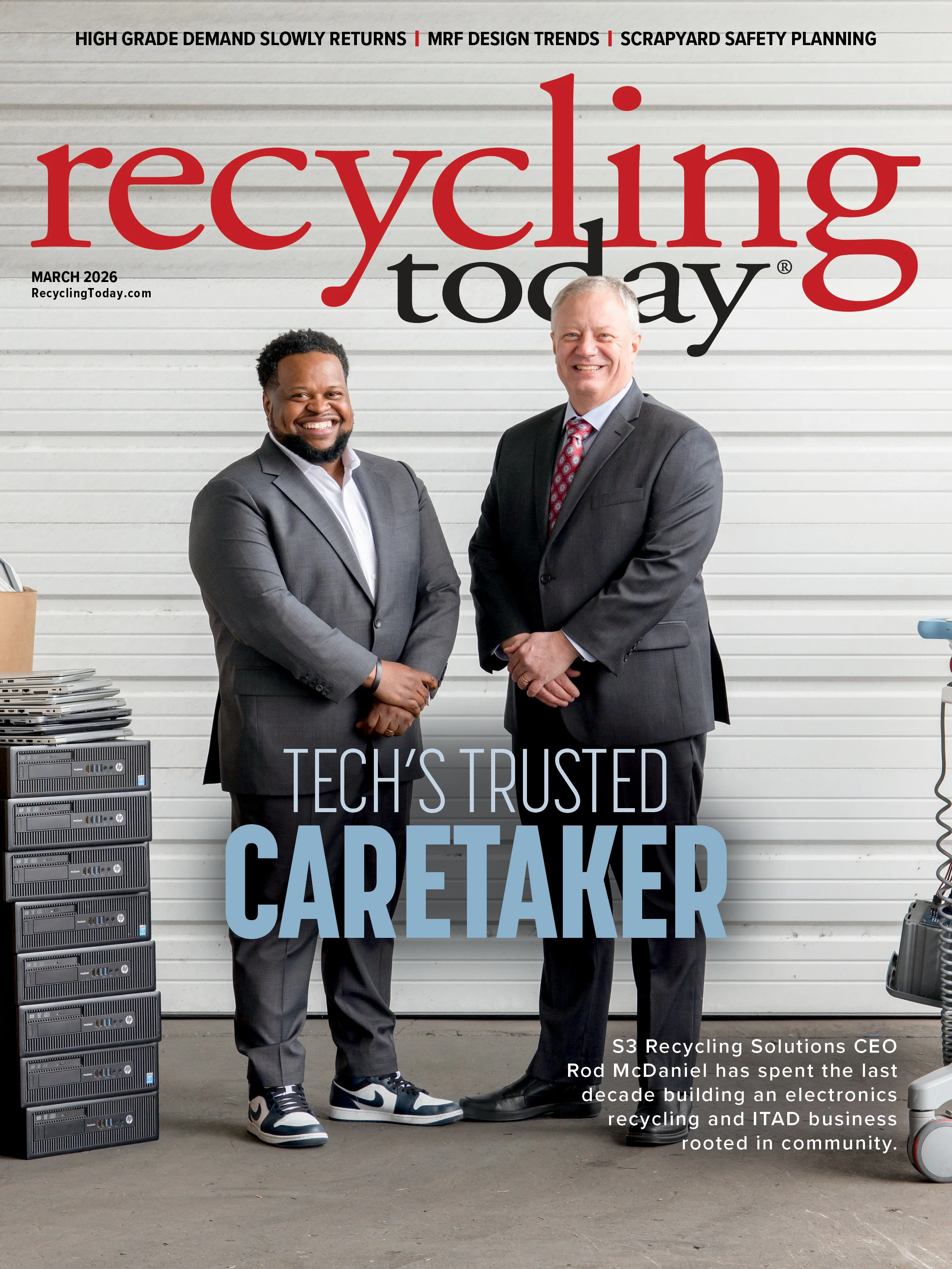
Explore the March 2026 Issue
Check out more from this issue and find your next story to read.
Latest from Recycling Today
- Oregon lawmakers pass battery recycling bill
- Volvo says loader updates improve efficiency
- One and One focuses on PCB recycling
- Indicators point to hiccups in steel demand momentum
- WM opens upgraded recycling facility in Southern California
- City of Providence to receive new collection carts through $7.4M investment
- CAA has submitted updated REM program plan in Oregon
- ReMA approves updates to inbound residential specs, paper stock guidelines