For several decades, multinational companies and governments have shown a willingness to relocate manufacturing from nations with developed economies to those with lower-cost labor and regulatory landscapes.
That business model has faced intense scrutiny since the COVID-19 pandemic, Russia’s invasion of Ukraine, attacks on ships in the Red Sea and other geopolitical factors that have made lengthy supply chains look less permanent than they appeared to be five years ago.
Subsequent reconsideration in the United States and European Union has focused on numerous manufacturing sectors and commodities, with metals and minerals labeled “critical” at the forefront.
If the shift is backed with big-ticket actions, it not only could influence trading patterns and supply chains for recyclers but could incentivize the recycling of items and materials that, in recent years, have not been considered prosperous revenue streams. For that to happen, proposed investments in smelters and refineries will have to move off the drawing board to become operational facilities.
Dispersing the centralized
The roster of critical minerals can vary by government jurisdiction or agency, though policymakers in the U.S. and the EU have tried to unify their lists and definitions.
But no matter which metals or minerals are included on the lists, it is likely that China currently dominates in the mining and production of those materials.
In terms of larger-volume metals, such as copper and aluminum, Chinese facilities produce more than half of the global totals, though companies in the U.S. have maintained a presence in those sectors.
For some minor metals, including those categorized as rare earth elements (REEs), Chinese companies mine or refine 90 percent or more of the global total. REEs used in the production of magnets and batteries include cerium, dysprosium, europium, lanthanum, neodymium and terbium.
Per U.S. Geological Survey data, Chinese mines produced 240,000 tons of the 350,000 tons of total global rare earths ore in 2023, a figure that amounts to 68.5 percent. That same year, the sole U.S. mine in Mountain Pass, California, produced 43,000 tons of rare earth ores, representing 12.3 percent of the world’s total.
But the U.S. mining presence is not matched in REE downstream processing.
According to the Washington-based Center for Strategic and International Studies (CSIS), as of 2023, China accounted for about 99 percent of global heavy REE processing.
“Despite being the world’s second-largest producer of REEs—thanks primarily to operations at Mountain Pass—the U.S. has long depended on China for REE separation,” the CSIS says in its July 2025 report. “Until early 2024, the U.S. was shipping most of its domestically mined REEs to China for processing.”
Geopolitical concerns that have helped underpin manufacturing and mining reshoring efforts in the U.S. have been amplified in President Donald Trump’s second term. Related policies have led to federal agency funding directed squarely at boosting REE production not only via mining and the downstream processing of ores but also by investing in increased recycled refining and smelting capacity to recover REEs and other critical metals.

Policies and plans
An August 2025 announcement from the Trump administration refers to what could be a direct pipeline to funding for those looking to invest in refineries or smelters.
The Department of Energy announced plans to issue notices of funding opportunities of nearly $1 billion tied to the domestic supply of critical minerals and materials supply chains, with more than half the total targeted toward recycling.
“For too long, the U.S. has relied on foreign actors to supply and process the critical materials that are essential to modern life and our national security,” Secretary of Energy Chris Wright said at that time.
Of the $1 billion in potential funding, $500 million will be available through the federal Battery Materials Processing and Battery Manufacturing and Recycling Grant program.
“The proposed funding opportunity supports demonstration and/or commercial facilities processing, recycling or utilizing for manufacturing critical materials which may include traditional battery minerals such as lithium, graphite, nickel, copper [and] aluminum, as well as other minerals that are contained within commercially available batteries, such as [REEs],” the department says.
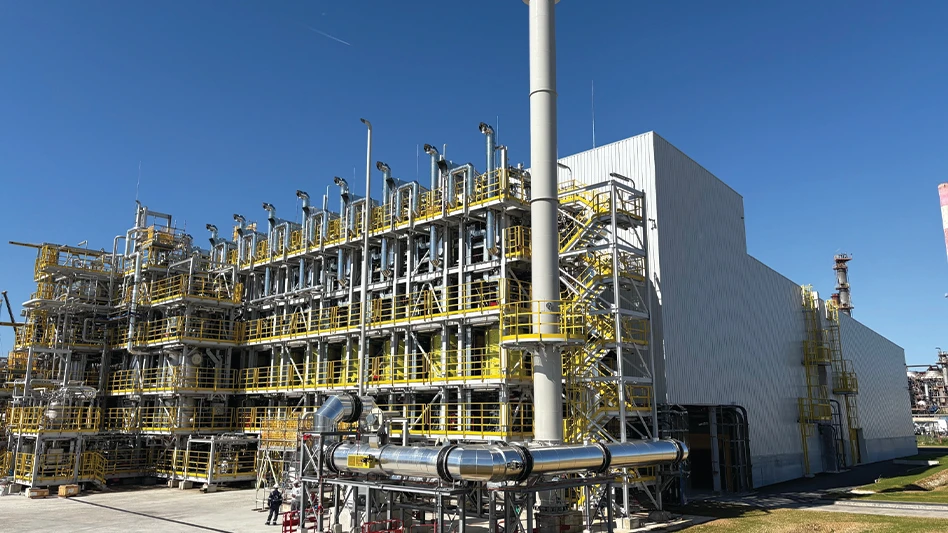
In the copper recycling sector, investments such as those by Germany-based Aurubis at its campus in Augusta, Georgia, preceded such government initiatives and provide a glimpse of the types of facilities that could come online to boost refining and smelting capacity in the U.S.
In July 2025, Apple Inc. announced a commitment to invest $500 million in MP Materials, a company Apple says is the only fully integrated rare earth producer in the U.S. As part of that arrangement, the two companies will work together to establish a REE recycling line in Mountain Pass and develop what Apple calls novel magnet materials and innovative processing technologies that are meant to enhance magnet performance
Following the announcement of government funding last year, more such announcements from private sector companies and investor groups followed.
In December, Seoul-based metals producer Korea Zinc announced plans to work in cooperation with the Department of Commerce and the Department of Defense to build a $7.4 billion smelting facility in Clarksville, Tennessee.
The company foresees annual capacity of 540,000 combined tons of 13 nonferrous metals in Tennessee and says the proposed facility will be modeled after its existing Onsan smelter in South Korea.
Korea Zinc says the Onsan complex is the world’s largest single-site smelter and notes that it has secured advanced technology to process complex raw materials, such as low-grade concentrates and scrap with high impurity levels, and established integrated zinc-lead-copper processes to maximize valuable metal recovery rates, demonstrating global competitiveness.
Finally, West Palm Beach, Florida-based Evolution Metals & Technologies Corp. (EM&T) announced it had adopted that name after completing a merger of Welsbach Technology Metals Acquisition Corp. and Evolution Metals LLC.
The firm plans to recover battery and magnet materials through a closed-loop recycling model at U.S. facility supported by a multifeedstock processing platform that integrates hydrometallurgical and pyrometallurgical technologies.
EM&T says its South Korea-based predecessor firms have been manufacturing rare earth magnets and magnet materials commercially for longer than 18 years.
How many new smelters and refineries are built in the U.S. will depend in part on shifts in the geopolitical landscape retaining their current shape but also on whether investors can achieve a return in a sector where not all new technologies pan out as hoped.
Achieving scale
Should companies and investors apply the proper technological solution to a recycled feedstock that is widely available, the room for growth in the U.S. nonferrous smelting and refining sector could be significant.
In a January analysis, England-based IDTechEx forecasts that the critical material recovery market value will exceed $66 billion and 8,150 metric tons in volume per year by 2046, as demand, waste volume and regulatory pressures all grow. IDTechEx says lithium-ion batteries and rare earth magnets are set to become key secondary sources of critical materials as commercially mature recycling technology capacity scales in anticipation of growing volume becoming available.
“Secondary sources are typically available at the point of consumption, require substantially lower capital investment to develop and are circular and sustainable,” the firm states. “Recycling technology approaches are emerging to enable recovery from waste. Long-loop magnet recycling using … hydrometallurgical processing, solvent extraction and liquid chromatography affords separated rare earth salts for resale into diverse application verticals.”
According to the IDTechEx report, pyrometallurgical and hydrometallurgical technologies are available commercially for recycling nickel, cobalt, copper, lithium and manganese, and emerging direct lithium-ion battery recycling technologies could offer a cheaper alternative for regenerating cathode materials.
IDTechEx predicts the global critical material recovery market will grow at a 9.2 percent compound annual growth rate until 2046, and critical battery material recycling and rare earth recovery represent the highest growth opportunities.
Explore the February 2026 Issue
Check out more from this issue and find your next story to read.
Latest from Recycling Today
- SA Recycling votes to remove United Steelworkers
- England's Environment Agency extension provides stability for metal shredding operators
- Schupan names new chief financial officer
- NAW looks ahead to July hearing in Oregon
- Recycle Coach partners with Bartec Municipal Technologies
- EPA proposes abandoned tire cleanup plan with focus on energy recovery
- BIR welcomes new policy officer for trade & environment
- Global Recycling Foundation recognizes Recycling Heroes