Do what you say you’re going to do. While the phrase sounds simple on the surface, for a company like Cozzi Recycling, it’s a way of life.
Operating a full-service scrapyard in Bellwood, Illinois, and a second retail facility nearby in Melrose Park, Cozzi Recycling has been in business in the Chicago area since 2009, processing a wide variety of ferrous and nonferrous metals. But the Cozzi name has carried significant weight in the industry for nearly 80 years, with the companies bearing that name earning a reputation as reliable, efficient and sustainability-minded recyclers serving businesses and individuals.
At the helm are brothers Frank Cozzi Sr. and Albert Cozzi, who serve as CEO and director, respectively. Each carries more than a half-century of industry experience. Frank Sr., in particular, has served as a past chair of the Institute of Scrap Recycling Industries, now known as the Recycled Materials Association. Both have continued to be influential voices in the industry.
Together, Frank Sr. and Albert have spent their careers building on the strong reputation that took root in the 1940s, which is when their father and grandfather, both also named Frank, started the family business, Frank Cozzi & Sons, in the Chicago area.
Now, they’re passing that reputation on to the next generation of the family-owned and -operated company, which includes Frank Sr.’s sons, Frank Jr. and Anthony, and nephews, Gregory Jr. and Peter. Gregory Cozzi Sr., Frank Sr. and Albert’s brother, also was an industry veteran and director at Cozzi Recycling until his death in 2020.
No matter the generation, the Cozzi business ethos has remained the same.
“Consistency is huge,” Peter says. “We’re consistent with our service. I don’t think we have many surprises. We don’t oversell and underperform.”
“We don’t try to sell something we’re not going to deliver on,” adds Frank Jr.
Movement through the years
Frank Cozzi & Sons began as a humble operation in the mid-1940s.
Frank Sr. says his grandfather had a small scrap facility, and his father operated a single truck. As his uncles became old enough to join the business, they also became truck drivers.
In the 1960s, the company’s name changed to Cozzi Iron & Metal Inc. and continued to expand through acquisitions. By the late 1980s, the company was considered one of the largest processors in the industry.
In 1997, Cozzi Iron & Metal merged with Chicago-based Metal Management Inc. The latter filed for Chapter 11 bankruptcy in 2000, and Albert and Frank Sr. held senior roles until leaving the company in 2004. After fulfilling a two-year noncompete agreement with Metal Management, the two joined Gregory Sr. and several other family members to start Cozzi Consulting Group in 2006 in Burr Ridge, Illinois, with the aim of marketing scrap metal, paper and plastic.
Frank Sr. began consulting for another Chicago-area firm, O’Brien Recycling, in 2006 and, in 2009, Cozzi Consulting and O’Brien merged to form Cozzi O’Brien Recycling, which was headquartered in Franklin Park, Illinois. The new entity operated several scrapyards in the area.
In 2014, the Cozzis absorbed O’Brien recycling, renaming the company Cozzi Recycling LLC, with its headquarters at its 12-acre Bellwood facility.
Cozzi Recycling started with slightly more than 40 employees but, through consistent growth, it now boasts around 90, including a number of long-tenured workers—some of whom have as many as three decades of experience.
“We have several people that came to us that worked at our old company,” Frank Sr. says. “When they found out we were back in business, several came back to work with us. I’d say 85 percent of our employees I’d put in that long-term category.”

Recycling in their blood
Like many family-owned and -operated scrap businesses, members of the Cozzi family have contributed from young ages, performing a variety of tasks and learning what makes the company hum.
For instance, Frank Sr. recalls one of his first sorting jobs, which involved separating scrap that was supplied by a golf club manufacturer.
“The drivers back then had either aluminum or brass faces on them,” he says. “This [customer], when they were making the clubs, all that stuff got thrown into the same pile of scrap. And I had to sort the aluminum from the brass, which wasn’t bad until summertime when we moved all that sorting outside, and the sun was so bright that after an hour of sorting, you couldn’t tell one [metal] from the other.”
Both Frank Sr. and Albert drove trucks for Cozzi Iron & Metal early in their careers, and one of their tasks was to remove furnaces and boilers from people’s homes as their father had an agreement with different ventilation and heating contractors.
“Albert was always competitive— always tried to see who could lift the most, who could carry the most, who could fill the most loads in a day,” Frank Sr. says. “That kind of friendly competition motivated us.”
Similar jobs were passed on to the next generation, though in the view of Frank Jr. and Anthony, they initially were designed to teach a lesson.
“I couldn’t have been more than 5, and Frank and I really upset my mom, so she sent us to work with my dad on a Saturday, he let us into the shop for hours and we were on the floor sorting washers,” Anthony says. “It was a very impactful punishment. My mom never did that again because we came back so dirty.”
Gregory Sr.’s sons, Gregory Jr. and Peter, remember visiting Cozzi Iron & Metal on weekends and spending time in his office, which included a pool table and practice putting green.
At a young age, Gregory Jr. recalls being tasked with placing Cozzi stickers on small cigar holders the company handed out. Peter’s first job came when he was in high school, painting boxes green, then red a year later. Before the Bellwood facility was paved, he would pick steel off the ground that had been left behind during demolition work.
After heading to college, all four of the fourth-generation Cozzis found their way back to the family business in different roles. Frank Jr. and Anthony are vice presidents, with Frank Jr. focused on maintenance, dispatch and accounting, and Anthony managing day-to-day operations for ferrous and nonferrous, as well as safety. Gregory Jr. is the maintenance manager, helping with shearing and shredding operations, and Peter is an account manager and scale coordinator, also managing the company’s software systems.
While filling their roles, each has found his calling, helping to serve customers that have worked with Cozzi-operated companies for as long as 40 and 50 years in some cases.
“Our family’s always been really close, and we’ve always emphasized that family isn’t everything, it’s the only thing,” Gregory Jr. says. “What gets me out of bed every morning is going to work with my brother, my cousins, my uncles; and we’re all working toward the same goal.”

Processing evolution
Frank Sr. says Cozzi Recycling directs a lot of its business toward customers in the construction and demolition industry, though both facilities accept a wide array of recyclables.
The company buys ferrous scrap, such as steel busheling, baling clips, machine shop turnings, plate and structural solids and more. On the nonferrous side, the company buys all grades of stainless steel, aluminum, copper and precious metals, as well as high-nickel alloys.
Cozzi Recycling operates a fleet of 21 trucks it uses for pickup services and offers bins and containers of different sizes to meet the needs of businesses, contractors and manufacturers.
Frank Sr. says the 2013 installation of a 1,000-horsepower Bonfiglioli hammermill in Bellwood increased the company’s capabilities. Not long after that, Cozzi Recycling added two stationary shears, also made by Italy-based Bonfiglioli, and a pair of excavator-mounted mobile shears.
In 2024, the company installed a Blue Devil shredder made by Italy-based Zato that is used to preshred materials, such as white goods and sheet iron, to support the hammermill shredder.
Downstream from the shredding operation, nonferrous metals are sorted using a combination of an eddy current system, a Finder sorting system developed by Buffalo, New York-based Wendt Corp. that can detect complete objects and sort metal particles by shape, size and signal intensity and by hand.
“The eddy currents certainly have changed the way the waste stream is processed at a shredder,” Frank Sr. says. “I think some of these new machines, with the Finders we’ve installed that pick up some of the copper we miss [have been helpful]. There’s a lot of things in the downstream of a shredding operation where it seems like every adjustment you make, you can pull a little more out.”
Since starting Cozzi Recycling, Frank Sr. says the company has leaned on the strong service reputation associated with the family name to separate itself in the crowded scrap processing market.
“The competition in Chicago has always been extremely tough,” he says. “We’ve looked at things a little bit differently [since forming Cozzi Recycling], where we’re not out to compete for every single ton. We want to make a legitimate profit and have relationships with those that are good people to do business with.
“A lot of our business now comes from the C&D people, and the guys we deal with are just great people to do business with. They have similar philosophies, similar operations and similar equipment. We have a lot in common, and we share information with them. It’s been very beneficial for both sides.”
Building a better business
In addition to consistent and efficient service, Cozzi Recycling prides itself on continuous improvement.
While the company has added processing equipment over the years, it also continues to invest in the Bellwood facility’s infrastructure. Roughly 90 percent of the yard is paved, and Frank Jr. says portions of the facility are patched every year.
“It’s a big expense, but it helps you keep everything clean and keeps dust from going into the neighborhood with the trucks going in and out,” he says.
In terms of running clean facilities, Anthony adds that vehicles entering and exiting “don’t leave a mark,” and if a mess is made, it is promptly cleaned up.
Anthony says everything the company does is geared toward operating a clean yard. The facility undergoes wet sweeping daily, scrap piles are watered down and spraying systems are installed at the shredders and discharge areas. The company also complies with all emissions standards that apply to its trucks and turns its fleet over often.
Recent improvements have been made with employees’ well-being in mind. In 2022, the Bellwood site was upgraded with a new lunchroom, locker rooms, offices and a meeting room.

A relationship business
Over the years, the Cozzis have striven to be a good neighbor in their community.
While Frank Sr. points to the importance of building good relationships with mayors, police and fire departments, for example, Gregory Jr. says community education also matters.
“We try to educate those around us about what we do and how we impact the recycling chain, whether it’s going to elementary schools to educate them on what we do or doing can drives or touch-a-truck events,” he says.
Peter is working to get Jason Learning, a nonprofit group that provides curriculum and learning experiences in science, technology, engineering and math, or STEM, and professional development for teachers, into local school districts, and the company participates in Bellwood’s annual Clean & Green Day of Service.
Through daily action, Cozzi Recycling strives to maintain the reputation the family members don’t take for granted.
“This is still a relationship business,” Frank Sr. says. “While I’m intrigued by AI [artificial intelligence] and the other things technology has given us, this is a relationship business, and you still have to get out and know your customers and help your customers be successful. That will help you be successful.”
Gregory Jr. says high standards set by older Cozzi generations have guided the younger ones.
“Growing up, it meant something to be a Cozzi,” he says. “My dad always told me, you’re a Cozzi, you’re a leader, you lead by example, and it’s all about outworking the next guy. The best thing we can do is honor the generations that have been there before us and maintain that standard and that level of excellence.”
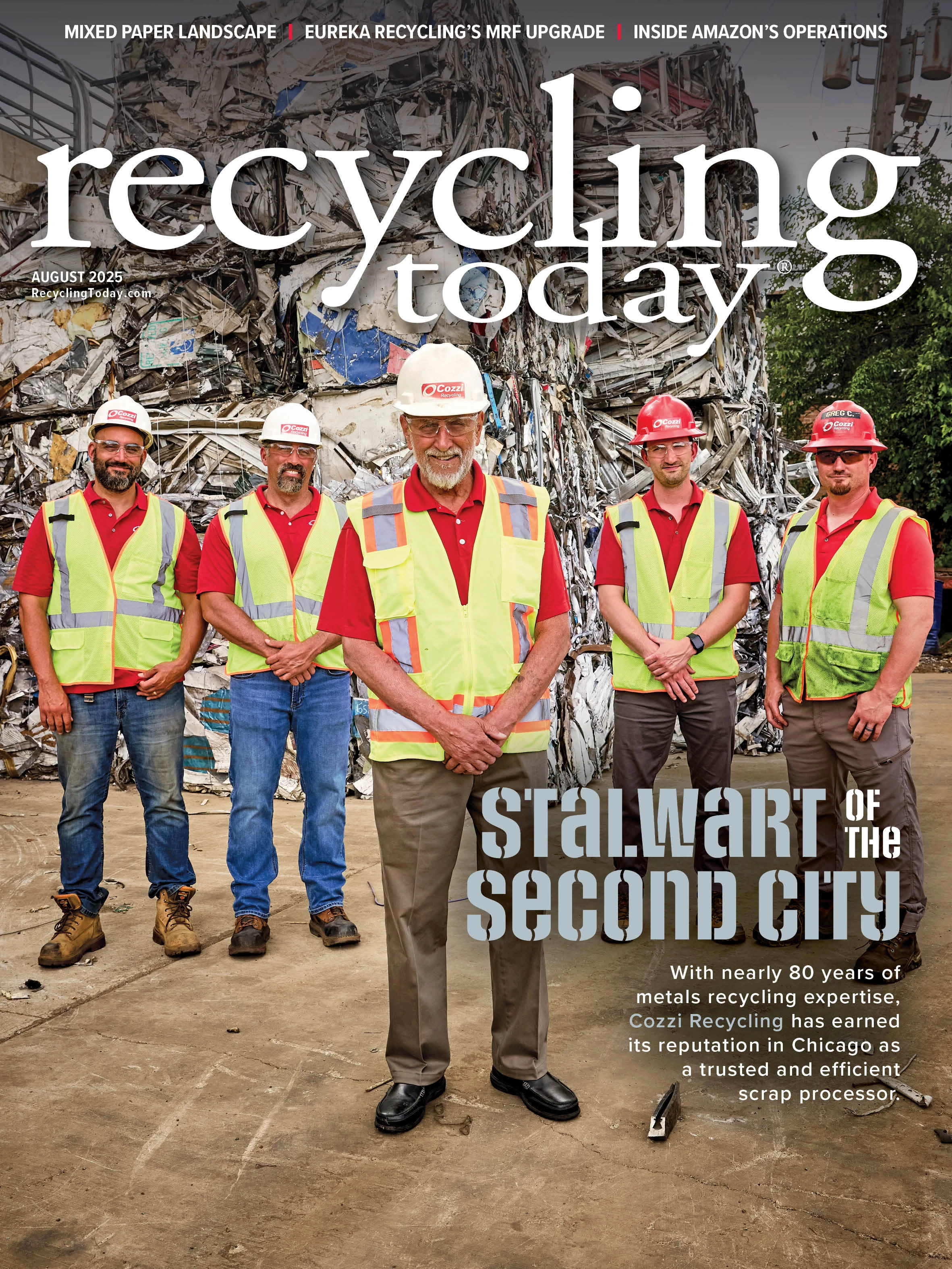
Explore the August 2025 Issue
Check out more from this issue and find your next story to read.
Latest from Recycling Today
- Fleetio launches AI capability to accelerate fleet maintenance approvals
- The Metals Agency receives approval for export credit insurance
- Recycle Ann Arbor extends drop-off station operating hours
- Sybilion seeks to help manufacturers confidently address volatility
- Rio Tinto, Prysmian partner on low-carbon aluminum solutions for data centers
- Unilever criticized for plastics approach
- USTR to study additional steel, aluminum tariffs
- Electrified Materials adds processing capacity