China’s pursuit of green steel is unfolding at a time when its traditional growth engines, especially real estate, have stalled, exposing long-standing structural weaknesses in domestic demand.
Meanwhile, the country’s export market is facing setbacks from import tariffs and antidumping investigations. As the world’s largest steel producer, China emits roughly 2.2 gigatons of CO2 annually from steelmaking alone, underpinned by a vast fleet of newer blast furnaces that average only 12 years in age.
What is green steel?
Green steel refers to steel produced with significantly lower carbon intensity, typically through scrap-based electric arc furnaces (EAFs), hydrogen-based direct reduction and ultra-low emission technologies rather than traditional coke-fueled blast furnace-basic oxygen furnace (BF-BOF) systems.
A critical pillar of China’s long-term decarbonization strategy is the gradual shift toward direct-reduced iron (DRI), a technology that replaces coke with natural gas or hydrogen to convert iron ore into a purer, lower-carbon metallic iron.
Unlike the BF route, which locks in high CO2 emissions, DRI enables steel production using hydrogen or natural gas, cutting emissions by 50-90 percent depending on the reductant used. Global research, including work by India-based CEEW (Council on Energy, Environment and Water) and Tata Steel Nederland, shows that hydrogen-based DRI paired with EAFs forms the backbone of truly green steel, allowing mills to operate without using coal and enabling the integration of high-quality iron into electric furnaces without compromising on metallurgical properties.
China’s adoption of DRI has been slow so far, given limited natural gas availability and the technical requirement for high-grade ore pellets, but the Chinese government explicitly is encouraging hydrogen-DRI pilot plants in coastal regions with access to imported hydrogen and renewable power.

Making a case for green steel
China’s reassessment of its steel strategy largely is driven by a collapsing property sector, with its share of steel demand expected to fall from 40 percent in 2020 to 23 percent over the long term, while overall construction is expected to decline from 60 percent to 48 percent. As domestic demand contracts, exports have surged, reaching 110 million metric tons in 2024, a nine-year high, triggering a global backlash.
Though exports remain historically strong, Goldman Sachs expected an 8 percent dip in 2025, which still would be the second-highest net volume on record. However, much of this growth is in semifinished billets rather than in the high-end, value-added products favored by policymakers.
Multiple governments, including Vietnam, South Korea, the European Union and India, have launched antidumping probes against Chinese steel, reinforcing Beijing’s urgency to pivot toward higher-grade, compliant and greener steel to maintain global market access.
This shifting trade landscape has forced Beijing to pivot from its earlier volume-driven steel production model to a quality and sustainability-driven one, partly to ease diplomatic tensions and partly to secure long-term competitiveness in advanced markets where carbon standards are tightening.
The urgency from China to scale these technologies is amplified by the global trade environment, which has turned sharply against high-emission steel.
The United States has imposed tariffs on Chinese steel exceeding 25 percent in several categories and actively is shifting toward a “clean steel club” model that favors low-carbon producers.
Simultaneously, the EU’s Carbon Border Adjustment Mechanism (CBAM) on global emissions and trade, which took effect Jan. 1, is emerging as one of the strongest external pressures facing China’s steel sector. As the world’s first carbon tariff on imports, CBAM will apply charges on carbon-intensive products, including iron ore, steel, aluminum, cement and hydrogen, effectively rewarding low-emission producers while penalizing conventional high-carbon steel.

A transformation full of challenges
China has committed to developing greener technologies to tackle emissions from its huge steel industry. Notably, Beijing set a goal to produce 15 percent of its crude steel using EAFs by 2025 and to raise that share to 20 percent by the end of the decade.
But China’s green transformation faces steep technological hurdles.
The country is lagging on targets to replace coal-fired BFs with EAF technology, which uses recycled steel rather than iron ore. Of the more than 250 green steel projects announced globally, only about 15 percent are in China, and EAF penetration has stagnated at 9-10 percent for the past five years despite policy support. By 2030, however, three-quarters of China’s BF capacity will reach midlife, forcing a critical choice to reline these furnaces, locking in two more decades of emissions, or replace them with lower-carbon EAF units, which are costlier upfront but crucial for climate targets.
Ideally, China’s existing EAF capacity of around 150 million metric tons would be enough to meet the 15 percent target, but utilization rates have remained low, as reported by U.S. think tank Global Energy Monitor.
Further, the country’s share of EAF-made steel reached 10 percent in 2024, slightly higher than 9.7 percent a year earlier, according to United Kingdom-based consulting firm Wood Mackenzie.
Declining steel demand, low recycling rates, limited recycled steel supplies, electricity supply restrictions and lingering overcapacity concerns are hindering the move toward lower-emission steel production in China.

Policy changes and support
China is implementing a carefully sequenced policy framework that avoids the disruptive steel production crackdowns of past years.
The country’s Ministry of Industry and Information Technology is planning continued annual output cuts, a ban on new steel capacity and a removal of outdated assets while supporting technologically advanced enterprises and targeting 4 percent annual growth in value-added steel output through this year. New capacity can be added only if 1.5 times of existing capacity is eliminated, and 80 percent of total capacity had to meet ultra-low emission standards by the end of 2025.
At the same time, Beijing is directing subsidies and financing toward specialty alloys, automotive steel and green steel while deprioritizing construction rebar and commodity-grade materials.
ResponsibleSteel and other certification entities also are moving BF steel toward green steel categories with decarbonization phases and material sourcing progress levels.
Amid the challenges, several green steel projects and plans are emerging, though they still are modest relative to the industry’s size.
China intends to continue annual steel output cuts through this year, expand pilot projects in hydrogen metallurgy, deepen digital and energy-efficiency upgrades and accelerate large-scale consolidation to raise the top 10 steelmakers’ share from 44 percent to 60 percent.
The Chinese central government also aims to steer demand growth toward electrification, electric vehicles, renewable energy and artificial intelligence-related industries, sectors that are expected to account for 10 percent of steel demand by 2030 compared with declining contributions from construction and housing.
Some Chinese steelmakers have begun rolling out early-stage projects that are aimed at hydrogen metallurgy and ultra-low emission processes. Baowu’s Zhanjiang pilot integrates hydrogen-enriched BF injection while planning for a future DRI module, creating a path to gradually reduce coke dependency. Baowu’s Zhanjiang Iron and Steel Zero-Carbon Demonstration Plant’s 1 million-metric-ton hydrogen-based shaft furnace began production in December 2023. This plant could reduce 500,000 metric tons of CO2 emissions per year compared with BF steel, Baowu says.
Also, HBIS Group’s Xuangang demonstration plant is testing hydrogen-rich smelting technologies and advanced pelletization processes designed for future hydrogen-DRI integration. The company’s 1.2 million-ton hydrogen pilot plant delivered its first green DRI products in 2023 with 94 percent metallization and emissions reductions compared with BF-BOF production. It is ramping up to planned capacity.
Though modest in scale compared with the country’s vast steel system, these projects mark the first steps in a broader industrial shift.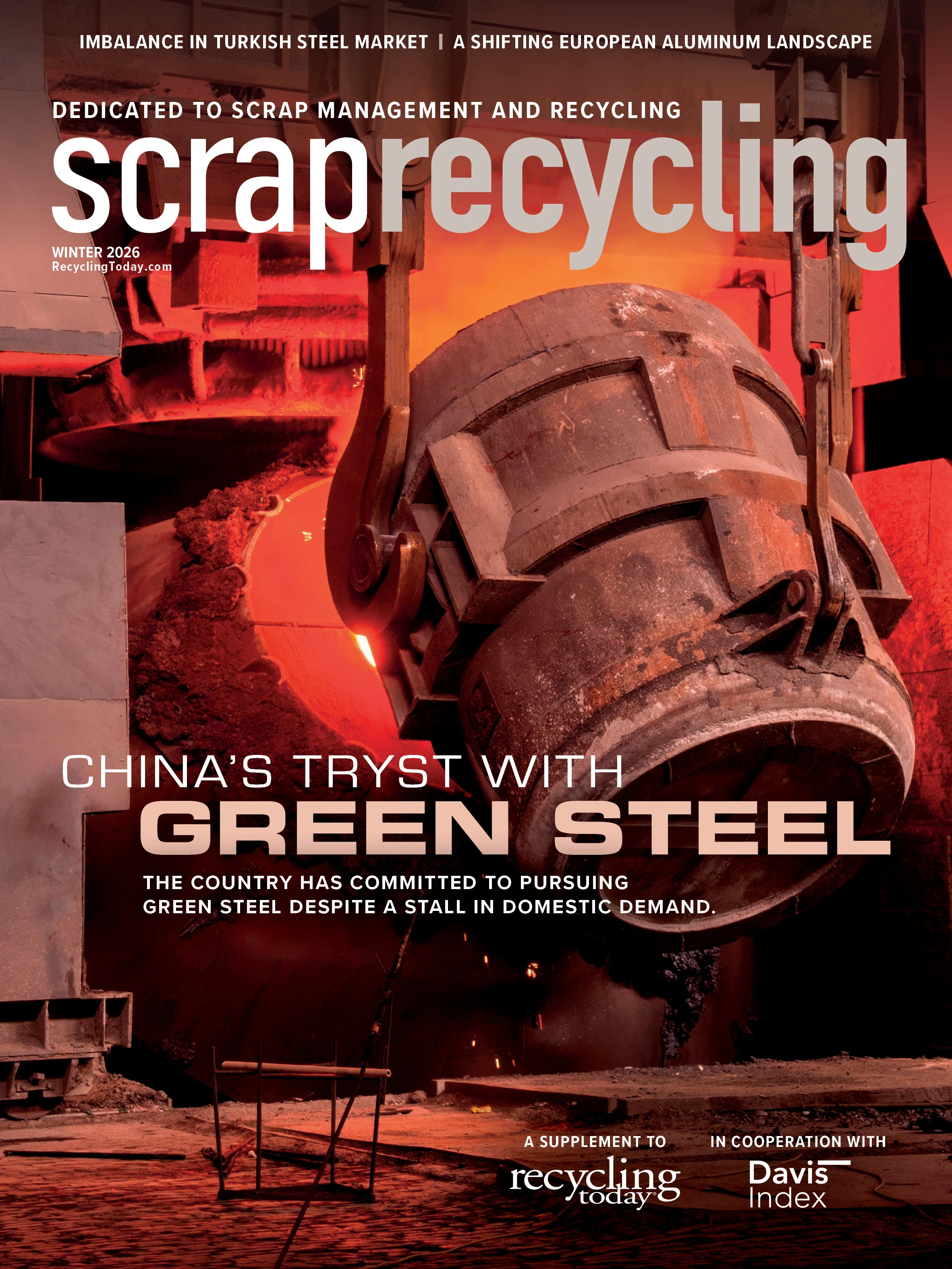
Explore the Winter 2026 Scrap Recycling Issue
Check out more from this issue and find your next story to read.
Latest from Recycling Today
- Steel output rises in top economies in January
- Thommen Group announces personnel changes
- International Paper to close South Carolina container plant
- A look inside WM’s new $90M south Florida MRF
- Waste to Resource Ontario announces new co-chairs
- WIH Resource Group adds senior associate
- BlueScope rejects recent SGH, SDI bid and notes terms for additional engagement
- Picvisa, Girbau to launch textile sorting plant in Europe