Robin Wiener’s 36-year career at the Recycled Materials Association (ReMA) is proof of the draw of the recycling industry.
“What I thought would be a steppingstone in my career journey became a lifelong commitment,” Wiener says. “It is true when they say that this industry grabs a hold and becomes so much more than a job.”
Wiener was hired as director of environmental compliance at ReMA, then ISRI, or the Institute of Scrap Recycling Industries, in 1989.
“I knew little about recycling and nothing about the recycled materials industry, or trade associations for that matter,” she says. “I was in law school at night when I started and just looking for a place located closer to the law school where I could continue working on environmental policy issues, which I had been doing in my previous job.”
In 1997, Wiener was appointed executive director, with the board naming her president in March 2000.
During her career at ReMA, Wiener has witnessed the evolution of the recycling industry and the association. She shares her perspective on that evolution and the association’s advocacy work on behalf of the industry in the interview that follows.
Recycling Today (RT): How has the industry evolved since you began working at ReMA in 1989?

Robin Wiener (RW): The industry has evolved significantly. We’ve become much more technologically advanced, and the materials handled more diverse and, in some instances, more complicated to process. In addition, while the industry has and will always be rooted in family and family-owned businesses, we are seeing more and more involvement by larger corporate entities. We are also seeing how marketing, social media and these areas are enhancing recyclers’ abilities to reach growing audiences and highlight the significance of the work of the industry.
RT: Why was it important to rebrand from ISRI to ReMA last year? How do you see ReMA evolving over the next three to five years?
RW: In 2022, after a lot of research and with the help of Maslansky+Partners, we adopted a new “language lexicon” or “playbook” to better communicate who we are, what we do, why it matters and where we are headed as an industry. We did this because of negativity around the industry and a general misunderstanding on the part of lawmakers and regulators about who we are and what we do. In addition, we had found that our messages were getting lost in the noise of others claiming to be the voice of recycling. And while messaging around sustainability was taking off, our industry was not getting credit for our important role.
The change we introduced in how we spoke about the industry quickly resulted in a change in how others saw us. We were no longer the scrap recycling industry; we are the recycled materials industry, and we now needed our brand to reflect the story we were now telling and to change how we are seen without changing who we are. ISRI no longer worked. If we wanted to have the world see us differently for who we truly are, we had to stop calling ourselves the Institute of Scrap Recycling Industries. And that is just what we did in April 2024—we retired ISRI after more than 35 years and became ReMA, the Recycled Materials Association. Our new name is built from clear, strong words that resonate with the audiences we need to reach outside the industry. It focuses on what we make, the value we provide and the ways we touch millions of lives every day. Our tagline—Sustainable. Resilient. Essential.—further emphasizes the industry’s core benefits to society and attributes.
We’ve seen great success with our new name as it resonates much more when speaking with lawmakers as well as general audiences and helps emphasize our essential role in the manufacturing supply chain.
Over the next three to five years, I see ReMA continuing to evolve as the needs of the industry do, too. From the evolution of AI [artificial intelligence] to the ever-changing tariff landscape, we will continue to be at the forefront of advocating in support of the recycled materials industry.
And, of course, we will continue to develop all the tools needed to effectively advocate for the industry and share the value our members bring to their communities, the global economy, the manufacturing supply chain and a sustainable environment. That is the idea behind the brand awareness campaign we launched in D.C. earlier this year, which tells the story of how recycled materials are part of all that we touch and use every day. And the campaign is yielding great results—8 in 10 D.C. opinion-makers now view recycled materials as critical to infrastructure. And we have seen a significant uptick in our brand awareness, which is critical for us to be as effective as we need to be when advocating for members.
I also see ReMA continuing to develop more content that highlights the everyday items consumers rely on and that are possible thanks to recycled materials. This includes greater emphasis on education around residential recycling.
RT: What were some of the foremost issues that ReMA has helped the recycling industry to address over the years?
RW: Some of the foremost issues that ReMA has helped the recycled materials industry address over the years include:
- Protecting our industry from restrictions to global markets. We successfully defeated attempts to put restrictions on the export of recycled copper in 2004 and again this summer, protecting over $5 billion in trade from the U.S.
- Liability protection under the Superfund. After significant advocacy and grassroots efforts, we worked with members to secure passage of the Superfund Recycling Equity Act (SREA) in 1999. SREA corrects an unintended consequence of the Superfund that resulted in hundreds of millions of dollars of Superfund liability being imposed on the recycled materials industry.
- Workforce safety. In 2015, we signed the first ReMA (then ISRI) OSHA [Occupational Safety and Health Association] Alliance. We renewed the alliance in 2020 and again in September of this year. Safety has always been our No. 1 core value. We are proud to work with OSHA to provide resources for safe operations of recycled materials businesses. Our goal every single day is to ensure every single employee goes home safely. ReMA has received OSHA’s Susan Harwood grant for a number of years and has used it to provide safety training on topics such as hazard recognition and fire training to recyclers as well as first responders.
- Youth outreach. In partnership with Jason Learning, over 10 years ago, we created a K-12 recycling education curriculum that just this year won the 2025 Educators Pick Best of STEM Award. This effort is an important tool for raising awareness about the industry and introducing students to careers in recycling.
We also helped launch the original recycling caucuses in the Senate and the House in 2003, helping to raise awareness and education about recycling and the recycled materials industry throughout Congress. Then, in 2008, we secured legislation that provides a 50 percent accelerated depreciation allowance for qualified recycling equipment (RISE, or Recycling Investment Saves Energy, Act).

RT: What are the critical issues facing the industry now? What is ReMA doing from an advocacy standpoint to help address these issues?
RW: The health and success of our industry is dependent upon access to the global markets, and that is why fighting controls and restrictions on the export of our recycled materials will always be a top priority for ReMA. Last year, we exported $26.7 billion of recycled materials to manufacturers around the world. Without access to global markets, many operations would struggle, ultimately reducing the availability of recycled materials for both domestic and international use.
I am happy to share that through a multiprong effort involving aggressive advocacy on the Hill, within the Trump administration and elsewhere, ReMA was successful in pushing back against the imposition of export controls on recycled copper this summer. But the fight is not over as there is an effort in Washington now focused on export restrictions for recycled aluminum, and we will be fighting equally hard to oppose that effort.
The proliferation of lithium-ion batteries of all sizes—from small button batteries to large EV [electric vehicle] batteries—is another critical issue and a fundamental challenge for our industry.
Lithium-ion batteries are becoming increasingly prevalent in society. They are in so much of what we depend on from our watches and tech devices to kitchen appliances, toys, personal mobility devices and beyond. They also pose an unprecedented safety risk to our industry when placed in the wrong streams, while at the same time, they contain critical, strategically valuable materials. ReMA, working closely with our members, has embarked on a strategy that attempts to address issues raised through a combination of collaboration with industry and government stakeholders, education and awareness and technology.
Another critical issue for our industry is safeguarding our members from liability for the handling of consumer products containing PFAS [per- and polyfluoroalkyl substances]. Placing the responsibility of cleaning up PFAS contamination on entities that have neither created nor can avoid PFAS threatens the viability of essential industries, including recycled materials. We are working on the Hill and with EPA [Environmental Protection Agency] on this issue and earlier this year joined with other petitioners on litigation challenging EPA’s rule designating PFAS and PFOA [perfluorooctanoic acid] as hazardous substances under Superfund.
Of course, there are numerous other issues facing the industry that ReMA is actively engaged in, including EPR [extended producer responsibility], reliable rail service, metals theft, critical minerals and much, much more.
RT: What are some of the opportunities that lie ahead for the recycling industry? How can ReMA help recyclers capitalize on these opportunities?
RW: As the recycled materials industry continues to evolve, becoming more innovative and technologically advanced as well as finding new ways to process even more material, there are opportunities to process even more high-quality recycled materials and higher volumes. Through the relationships ReMA helps develop in the U.S. and globally and the networking platforms we provide for business connections, we are working hard to support our members’ and our industry’s growth.
Additionally, as the understanding and recognition of the important role that recycled materials have in the manufacturing supply chain continues to grow, I see greater opportunities presented through policy and public-private partnerships that will help members secure more reliable markets, access new funding streams and gain a competitive edge.
Government policies are increasingly focusing on measures such as infrastructure investment, which is crucial for making the investment needed for advanced sorting and processing technologies. Further, public-private partnerships represent a major area of opportunity. Collaborative efforts between recyclers, OEMs [original equipment manufacturers] and government bodies are essential for developing new end markets and funding large-scale infrastructure projects to accelerate the recycled materials industry’s capacity and technological innovation.
ReMA is uniquely positioned to help its members navigate and capitalize on these emerging opportunities in policy and partnerships. The association delivers critical insights and educational resources on impending legislation and evolving regulatory environment, ensuring members are well-prepared to meet new compliance requirements and seize emerging business opportunities.
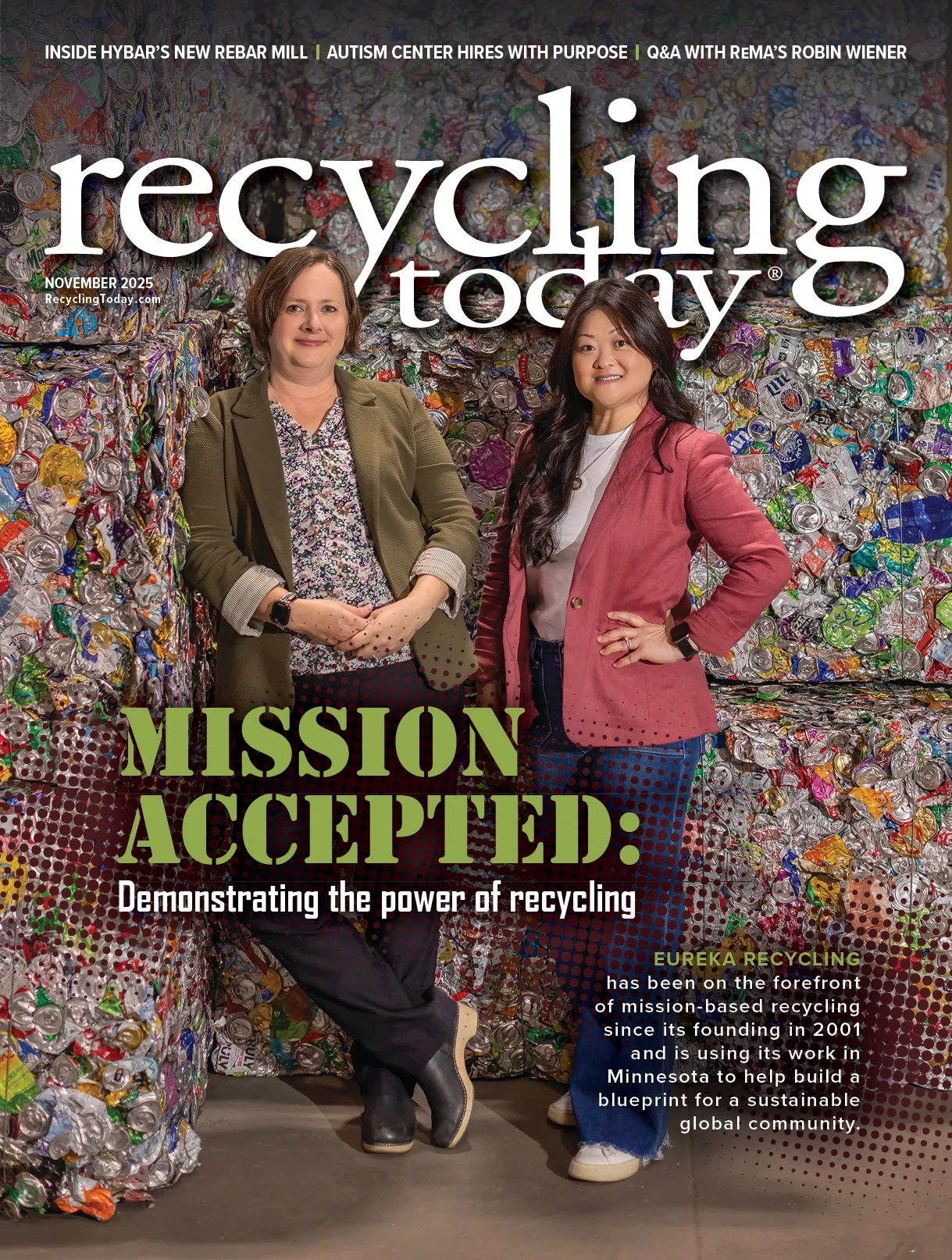
Explore the November 2025 Issue
Check out more from this issue and find your next story to read.
Latest from Recycling Today
- Fleetio launches AI capability to accelerate fleet maintenance approvals
- The Metals Agency receives approval for export credit insurance
- Recycle Ann Arbor extends drop-off station operating hours
- Sybilion seeks to help manufacturers confidently address volatility
- Rio Tinto, Prysmian partner on low-carbon aluminum solutions for data centers
- Unilever criticized for plastics approach
- USTR to study additional steel, aluminum tariffs
- Electrified Materials adds processing capacity