Numerous steel industry executives and analysts around the world have long decried the enormous Chinese steelmaking capacity that now is online, with those mills churning out and exporting semifinished and finished steel throughout this century.
The volume of Chinese steel that enters the United States most months represents a low single-digit percentage of steel consumed in the U.S. This July, the 25,000 tons of Chinese-made steel accepted as imported product placed China no higher than 14th on the list of steel exporters to the U.S., according to Census Bureau data, and pales in comparison to the more than 7 million tons or so of steel made monthly in the U.S.
According to groups like the Steel Industry Committee of the Paris-based Organization for Economic Cooperation and Development (OECD), rather than a loss of market share in U.S., the mass Chinese exports lead to ripple effects that can suppress global pricing and saturate any potential export markets U.S. mills might wish to serve.
For President Donald Trump, both in his first term and now in his second, tariffs placed on steel from China and beyond have been a preferred remedy to protect the profit margins and financial viability of U.S. steelmakers.
The initial effects of Trump administration tariffs can be discerned in some balance sheet figures and references by steel industry executives, but those effects are not identical for all companies.
Opening stakes, followed by a raise

The second Trump administration’s willingness to place tariffs on inbound steel was displayed almost immediately after he took office in late January.
By Feb. 11, a White House Fact Sheet spelled out the enactment of a 25 percent Section 232 tariff rate on inbound steel and aluminum from all nations, including several that had been exempted previously.
Those exemptions—granted to Argentina, Australia, Brazil, Canada, Japan, Mexico, South Korea, the European Union, Ukraine and the United Kingdom—had “inadvertently created loopholes that were exploited by China and others with excess steel and aluminum capacity,” the White House said at the time, referring to a practice known as triangular trading.
If buyers and sellers along the steel supply chain thought the matter would rest there, subsequent actions proved it was far from over.
In early April, a White House ceremony familiarized the U.S. with the notion of reciprocal tariffs, a proposed Trump administration regimen that assigned a looming but specific tariff rate to every nation and all goods from that nation.
Critical to the steel supply chain, these tariffs were intended to be stacked, or added to the existing Section 232 duties. The expectation from the White House was that individual nations would negotiate on their behalf to change the assigned tariff rates and other conditions of the reciprocal regimen, which has occurred only in some cases.
During the post-April news conference negotiating period, the White House singled out nations it deemed not suitably cooperative. In mid-July, this tactic singled out four of the largest overseas steel providers to the U.S.: Brazil, Canada, Mexico and South Korea.
While China (directly) shipped just 25,000 tons of steel to the U.S. in July, Canada and Brazil each shipped more than 300,000 tons, Mexico another 254,000 tons and South Korea a chart-topping 331,000 tons. (People suspicious of increased triangular trading traffic question whether some of those totals actually contain Chinese-made billets, slabs, coils and bars.)
As of early September, the future of many of these tariffs has been thrown into question by a lawsuit challenging the executive branch’s ability to place some of the tariffs.
That case is working its way toward the Supreme Court, but in the meantime, U.S. steelmakers have been operating for several months in an environment that has tariffs in place.
A familiar EAF advantage
The months of July and August brought several earnings reports from U.S. steelmakers and global companies with U.S. operations.
The White House tariffs likely are intended to offer financial backing to all steelmakers in the U.S. However, the mid-2025 earnings reports revealed a situation seen previously when either a downturn or turmoil hits the steel industry—operators of electric arc furnace (EAF) minimills perform better than companies with blast furnace/basic oxygen furnace (BOF) capacity.
The BOF plant operators often are referred to as integrated mill companies thanks to their historic approach to mine and process the iron they need to feed their furnaces. Combined with the complicated and expensive process it takes to idle a blast furnace, the two conditions can make pivoting quickly difficult for BOF mill owners.
In the second quarter covering April through June—when tariffs and pending tariffs were very much part of the landscape—BOF mill operator Cleveland-Cliffs reported a $470 million loss. The Cleveland-based company has iron and steel operations in the U.S. and now owns the Stelco BOF plant in Ontario.
Despite the firm’s 2025 financial struggles, Cliffs CEO and President Lourenco Goncalves has spoken out in favor of the Section 232 tariffs.
“Cleveland-Cliffs thanks President Donald Trump and Secretary of Commerce Howard Lutnick for taking decisive and concrete action that will deter tariff circumvention occurring in plain sight with stainless and electrical steel derivative products,” he said in mid-August.
Regarding his Canadian operations, Goncalves says the answer is not eliminating tariffs on U.S.-Canada cross-border steel trade but rather a bolstering of protections in Canada. He urged Canadian politicians “to grow a pair and understand that Canada is a very good country with a lot of potential, with a lot of critical minerals, with a lot of things that can make it a powerhouse.”
Regarding Canadian steel market protection, Goncalves urged elected officials there not to “lock in the import levels of 2024 that basically killed the Canadian steel industry.”
Fort Wayne, Indiana-based Steel Dynamics Inc. (SDI) saw a profitable second quarter this year. Its second-quarter net income was 28 percent higher compared with the prior quarter but about 30 percent lower compared with the second quarter of 2024.
SDI, which has invested in recycled-content aluminum slab production in Mexico and has metals recycling operations in that nation, is more guarded in its support of the tariff-heavy policies enacted in 2025.
“The uncertainty regarding trade policy continues to cause hesitancy in customer order patterns across our businesses, despite healthy underlying demand factors such as manufacturing onshoring, infrastructure program funding and increased regionalization of supply chains in the U.S.,” SDI CEO Mark D. Millett says.
“We strongly believe that as individual country trade agreements are negotiated and trade policy is generally stabilized in the coming months, strong pent-up demand for our products will result.”
Those involved in the steel sector likely have the same belief, or at least hope, as Millett. The track record of past steel tariffs offers a murkier view.
Bigger slice, smaller pie?

“The failure of these tariffs to work as designed and the economic harm they caused provide a foreboding tale of what we should expect to see result from the Trump administration’s new tariffs on steel and aluminum.”
That quote from Erica York of the Washington-based Tax Foundation was written not in 2025 but in 2018. It refers to metals sector tariffs introduced by President George W. Bush and to the first round of Trump tariffs.
“The effects of higher steel prices, largely a result of the steel tariffs, led to a loss of nearly 200,000 jobs in the steel consuming sector, a loss larger than the total employment of 187,500 in the steel producing sector at the time,” York adds, citing a 2003 research paper prepared for the Washington-based Consuming Industries Trade Action Coalition (CITAC) Foundation.
A study conducted by the Federal Reserve Bank reached a similar conclusion regarding the initial impact of the 2018 Trump tariffs.
“We find that the 2018 tariffs are associated with relative reductions in manufacturing employment and relative increases in producer prices,” Aaron Flaaen and Justin Pierce write in the report. “For manufacturing employment, a small boost from the import protection effect of tariffs is more than offset by larger drags from the effects of rising input costs and retaliatory tariffs.”
Offering a better comparison for U.S. steelmakers, raw steel production in the U.S. increased by 1.4 percent in 2019 compared with 2018, from 86.6 million metric tons to 87.8 million, according to the Washington-based American Iron & Steel Institute. (The onset of COVID-19 and accompanying restrictions in 2020 make any comparisons involving that year problematic).
 Entering the fall of this year, both AISI and its fellow Washington-based trade group the Steel Manufacturers Association (SMA) have expressed support for tariffs.
“AISI commends President Trump and Secretary Lutnick’s decisive action to broaden the tariff coverage to create a level playing field for American workers and strengthen the American steel industry,” AISI President and CEO Kevin Dempsey said in mid-August regarding the expansion of Section 232 tariffs on additional steel products.
“Thank you, President Trump and Secretary Lutnick, for continuing to prioritize the domestic steel industry and the national security our workers provide,” SMA President Philip K. Bell added around that same time.
With each new statement of trade cooperation or confrontation issued by the White House, both producers and recyclers of steel will be watching closely to see how it will impact their operations and profit margins.
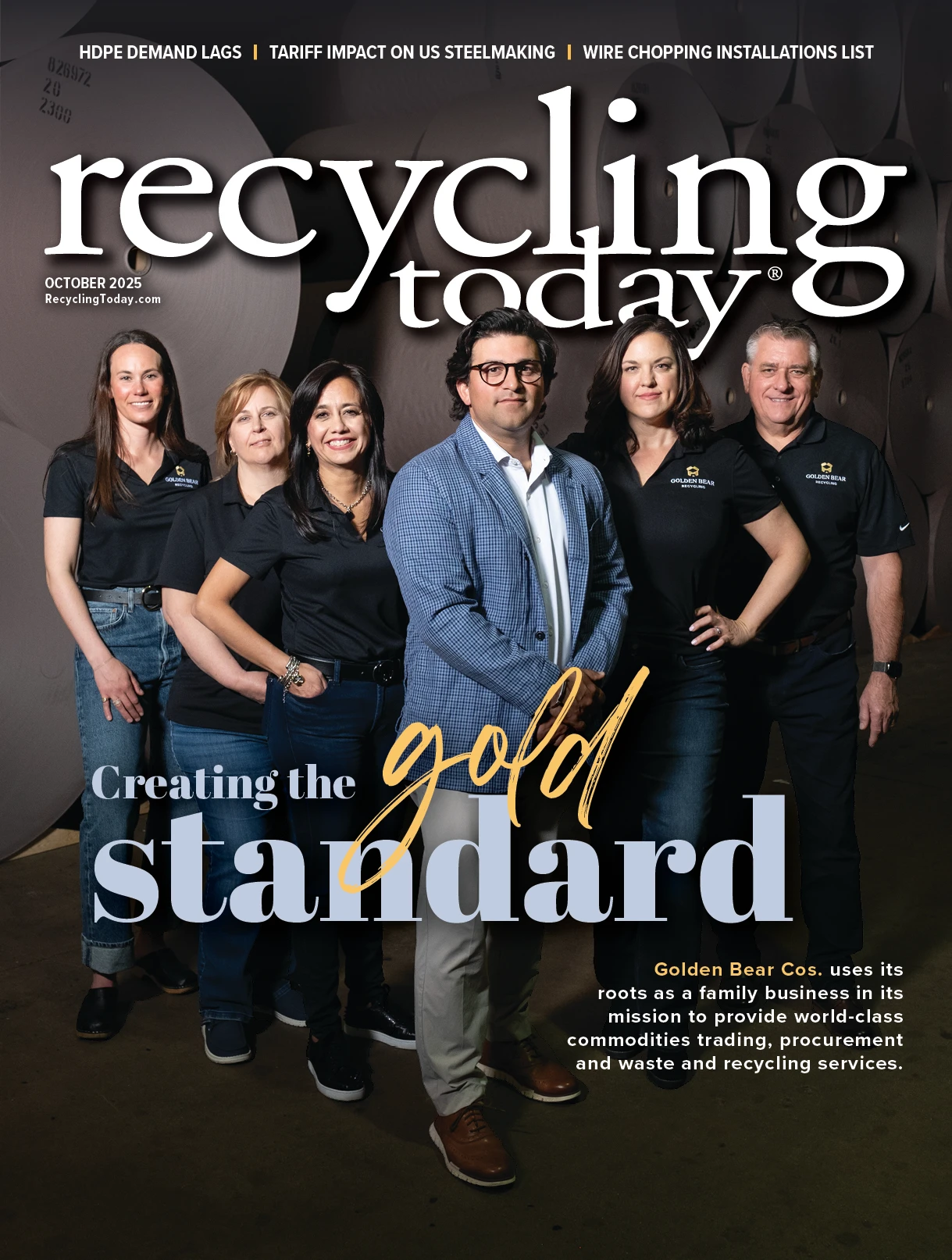
Explore the October 2025 Issue
Check out more from this issue and find your next story to read.
Latest from Recycling Today
- Fleetio launches AI capability to accelerate fleet maintenance approvals
- The Metals Agency receives approval for export credit insurance
- Recycle Ann Arbor extends drop-off station operating hours
- Sybilion seeks to help manufacturers confidently address volatility
- Rio Tinto, Prysmian partner on low-carbon aluminum solutions for data centers
- Unilever criticized for plastics approach
- USTR to study additional steel, aluminum tariffs
- Electrified Materials adds processing capacity