ERI and ReElement Technologies Corp., a portfolio firm of American Resources Corp., have announced a strategic partnership to recover and refine rare earth elements (REEs) from end-of-life electronics.
Fresno, California-based ERI is a leading information technology asset disposition and electronics recycling firm with additional processing operations in Goodyear, Arizona; Plainfield, Indiana; Holliston, Massachusetts; Lincoln Park, New Jersey; Flower Mound, Texas; and Kent, Washington.
The company’s Fresno and Plainfield locations are its first sites to aggregate and ship material to ReElement.
“We are starting small with smart watches, earbuds, speakers and smaller hard drives,” ERI Chairman and CEO John Shegerian says. “We will increase [our shipments] as our volumes increase and their volumes increase.”
ERI is sorting material by product type and preparing it according to the specifications established by ReElement, which is constructing a second facility, measuring 400,000 square feet, in Marion, Indiana, that will open early this year.
ReElement, headquartered in Fishers, Indiana, operates a commercial qualification facility in Noblesville, Indiana, that measures 700 square meters, or more than 7,500 square feet, and produces rare earth oxides and critical battery elements.
ReElement Chairman and CEO Mark Jensen says the company’s Marion site will be the largest rare earth oxide producer in the country once it’s operational, with the ability to produce 9,000 metric tons of purified rare earth oxides from recycled inputs as well as virgin ores.
“We can take everything [ERI] can produce,” he says.
Jensen says ERI’s strengths lie in aggregating and breaking down material, adding that the partners are working to establish how far ERI will need to break down material versus when it makes more sense for ReElement to do so.
“The economics will dictate that,” he says, adding that the partners also are looking at how to extend their relationship beyond the U.S., with Shegerian noting that ERI plans to add locations in Japan, the Emirates, India and Canada in the near future.
“We can win additional business together to make sure these products get back in the supply chain,” Jansen continues, noting that 95-98 percent of REEs currently end up in landfills. “I’m highly confident we can expand this partnership together.”
Like-minded partners
Shegerian says ERI has been in contact over the years with various companies that planned to something akin to what ReElement does. However, they either had no funding or scalable technology, “and the people weren’t the right people.”
Over a year of meetings and negotiations, Shegerian says, it was clear that ReElement was using technology that accomplished what the company said it was going to do.
“They aligned with us from a DNA and chemistry perspective,” he adds, noting both companies recognize the value of long-term partnerships. ERI has partnerships with South Korea-based LS-Nikko Copper, Alcoa and Redwood Materials, while ReElement has partnered with South Korea-based Posco International and Vulcan Elements, a U.S. rare earth magnet manufacturer.
Shegerian describes ReElement’s team as “tireless entrepreneurs, relentless innovators and kind and nice people.”
Jensen describes ERI as a world-class leader in the information technology asset disposition and electronics recycling sector, adding that ReElement wanted to partner with the best company that could provide aggregation services.
“ERI is a trusted partner to leading U.S. technology companies and hyperscalers, and their ability to efficiently source and process recycled magnet material is unmatched,” he says in a news release announcing the partnership. “Pairing their feedstock capabilities with ReElement’s advanced refining platform positions us to accelerate true circularity for critical minerals in the United States and deliver high-purity rare earth elements for our current and expanding customer base.”
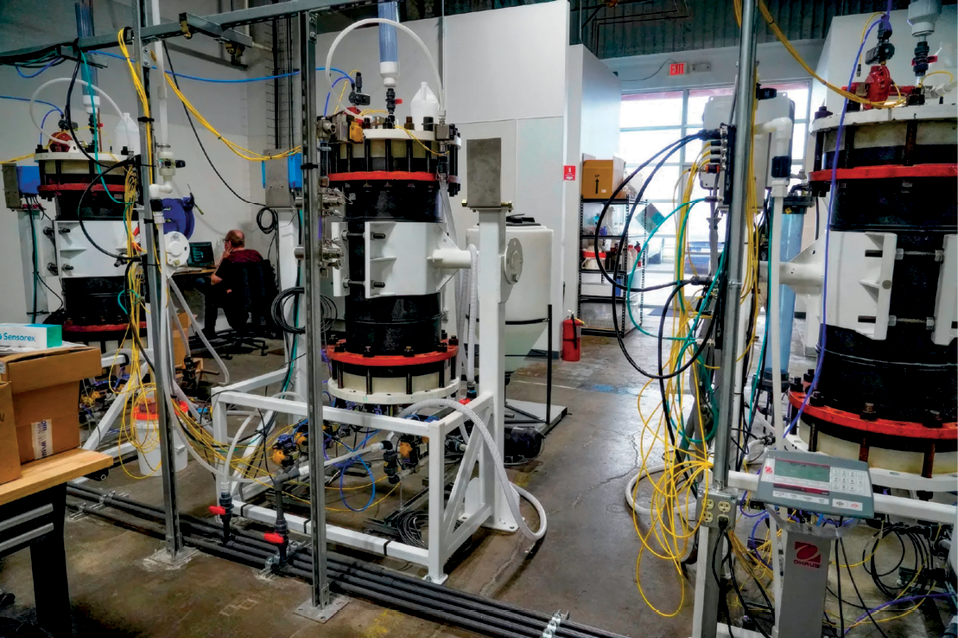
ReElement’s technology
The end-of-life magnets that ReElement sources through ERI are processed into an aqueous-based solution to be separated and purified back to magnet-grade material for use in manufacturing.
Its use of chromatography, a separation technique that is widely used in chemical laboratories, replaces the need for hydrometallurgical or solvent extraction in the separation and purification step.
ReElement’s patented process is able to purify targeted materials on an isolated or mixed basis, according to the company.
Chromatography was developed over decades and is to refine sugar and to produce insulin and other pharmaceuticals.
“The difference in what we do versus legacy technology is use densely packed columns with resins that are predicated on what we want to separate,” Jensen says.
He adds that the company’s collaboration with ERI is extremely important to the budding REE recycling industry to help drive down cost structure.
“I’ve operated in the commodity industry for 25 years,” Jensen continues. “If you don’t care about cost in that industry, you’re not going to be around for long. We are focusing on working with partners that are best in class—we don’t want to compete against them but work collectively to make one another’s business better.”
Building resilience
The agreement between ReElement and ERI strengthens the United States’ ability to establish a circular and secure supply chain for REEs at a time of growing strategic demand, the business partners say.
By integrating ERI’s scale in responsible electronics recycling with ReElement’s advanced, modular refining platform, the partnership provides a consistent pathway to generate high-value, domestically sourced mineral output.
ReElement recently benefited from a $1.4 billion joint partnership of with the U.S Department of War’s Office of Strategic Capital (OSC) announced in November of last year. The funding supports growing ReElement’s partnership with Vulcan Elements to scale a vertically integrated, domestic rare earth magnet supply chain.
The OSC commitment, funded through the One Big Beautiful Bill Act, includes two separate loans, matched by private capital—$620 million to Vulcan Elements and $80 million to ReElement Technologies—with the U.S. Department of War receiving warrants in ReElement.
Shegerian says the Trump administration is very focused on growing domestic independence for REEs and other critical minerals that are essential to the growth of artificial intelligence, data centers and electric vehicles, and Japan and Canada are as well.
“They all want to do the same thing: … derisk from being dependent on [China],” he says. “Partnerships are always exciting, but this is so relevant to everything going on today.
“ReElement’s groundbreaking technology and solutions make it the leading refiner of high-performance critical battery and rare earth elements required in energy, transportation, defense and other technologies. This new relationship will open the door for a whole new wave of U.S.-based capabilities in the rare earth realm that will have both domestic and global implications.”
Explore the Winter 2026 Scrap Recycling Issue
Check out more from this issue and find your next story to read.
Latest from Recycling Today
- International Paper to close South Carolina container plant
- A look inside WM’s new $90M South Florida MRF
- Waste to Resource Ontario announces new co-chairs
- WIH Resource Group adds senior associate
- BlueScope rejects recent SGH, SDI bid and notes terms for additional engagement
- Picvisa, Girbau to launch textile sorting plant in Europe
- Kaiser lifts net income figure in 2025
- Sims’ Houston contract confirmed by Enstructure