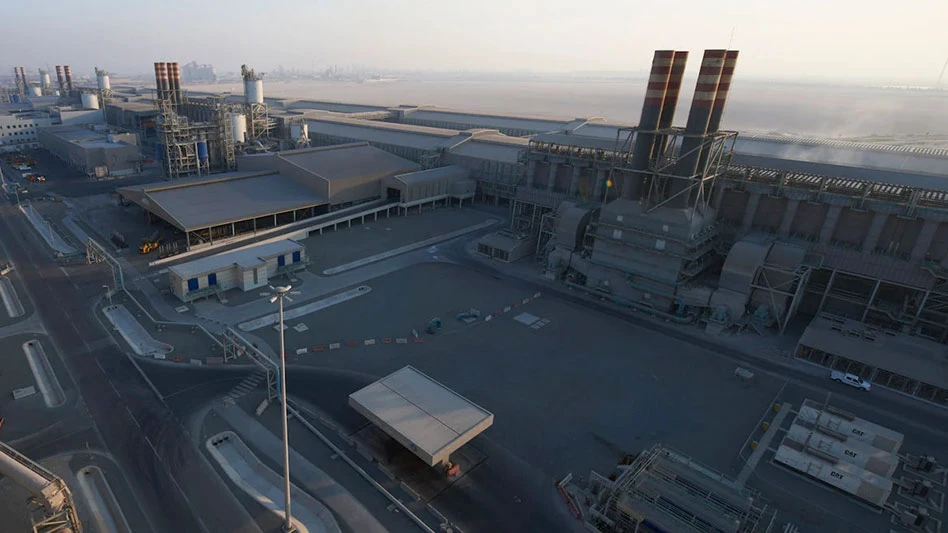
Steel slab rolling equipment at the newly constructed Hybar LLC facility in Osceola, Arkansas, began ramping up midway through 2025, marking another step forward for one of the newest recycled-content steelmakers in the United States.
Hybar also is commissioning its electric arc furnace (EAF) melt shop, which has been designed to consume 700,000 tons or more per year of ferrous scrap to produce as much as 700,000 tons per year of recycled-content steel rebar.
As of mid-October, the company’s Chief Financial Officer Ari Levy says Hybar and its employees are preparing to run the mill at full capacity in 2026, quickly establishing a new destination for several grades of recycled steel.
Relying on trusted suppliers
As Hybar’s mill has been under construction for the past two years on its 1,300-acre complex in Osceola, the company has noted melt shop capacity of 630,000 tons annually and the potential for the EAF to consume up to 700,000 tons of recycled steel per year as feedstock.
Levy tells Recycling Today, however, the company now envisions its melt shop will surpass those initial expectations—possibly as soon as 2026.
“Hybar expects to operate at full capacity levels in 2026,” Levy says. “While that would anticipate 630,000 net tons of finished products and 700,000 net tons of scrap consumed, per the mill’s rated capacity, Hybar expects to outrun its rated capacity by approximately 10 percent and achieve an annual output of 700,000 net tons of rebar production.”
The steelmaker worked with two European technology vendors on the installation of its furnace and rolling mill equipment: Germany-based SMS Group GmbH and the Primetals Technologies USA LLC business of London-based Primetals.
When Hybar commissioned its rolling mill this June, CEO Dave Stickler complimented the firm’s employees and its vendors.
“Hybar’s first day as a company was Aug. 1, 2023,” Stickler said at the time. “We had $1 billion of financing, three employees and huge ambitions. Our plan was to build the world’s most technically advanced, environmentally sustainable rebar steel minimill, along with our own Mississippi River port and the largest behind-the-meter solar and battery storage facility in the United States. I am extremely proud to say, ‘mission accomplished.’ Hats off to the Hybar team and our construction contractors for a job well done.”
Another Hybar’s key suppliers will be companies furnishing it with recycled steel grades for use in its melt shop.
“Hybar will be consuming a combination of heavy melting steel [HMS], shred and plate and structural [P&S] scrap grades,” Levy says.
He adds that Hybar’s philosophy entails trusting established companies in the recycled steel sector to provide the material the mill will need.
“Hybar has not invested in [scrap] sorting technology,” Levy tells Recycling Today. “That is best left to those that have committed to sorting as a fundamental part of their business.”
The company will tap into a wide existing network of scrap processors in the U.S., providing those suppliers with options in terms of how they ship their HMS, shred and P&S scrap.

Barges, trains and trucks
Hybar chose a site in Osceola that abuts the Mississippi River, and the firm has invested in port material handling equipment adjacent to the mill.
Levy anticipates the port will receive immediate use as Hybar brings in recycled steel for its melt shop, noting it is one of three transportation options for scrap processors and brokers.
“Hybar has all three modes of transportation available to support both inbound raw materials and outbound rebar shipments,” he says. “The mill has direct Mississippi River access via its own port operations, direct rail service provided by BNSF and excellent access to interstate highway transportation.
“Given its location, Hybar can reach up and down the river system for its inbound raw materials, [and] we estimate approximately 50 percent of raw material deliveries will take place via use of our port operations.”
As demonstrated in part by its investment in and planned use of solar power (See the sidebar, “An on-site array,” on Page 43), Hybar has made having a low-carbon footprint a high priority.
Advocates for river barge transportation have argued that waterborne shipping fits in well with corporate energy savings and emissions-reduction targets.
Bernert Barge Lines, which operates on the Columbia River and Snake River networks in Oregon, provides several figures that describe the energy savings and emissions aspects of barge shipping.
The firm calculates that a ton of material can travel 59 miles using 1 gallon of fuel. That same cargo can proceed 202 miles by train on 1 gallon of fuel and 514 miles by river barge. A ton of cargo moving 1,000 miles emits more than a half-pound of hydrocarbons by truck and nearly a half-pound by rail but less than one-tenth of a pound when traveling by barge, according to Bernert.

Markets tall and wide
The executives and investors who have brought the Hybar mill from concept to reality ultimately made a calculation that the U.S. economy could absorb the recycled-content rebar the company will produce in Osceola.
“Hybar’s focus is to convert its raw materials to high-quality rebar products at a world-class conversion cost,” Levy explains. “The focus is to also provide the highest levels of customer service with a commitment to not compete with our customers, unlike [some of] our strongest competitors.”
While Levy does not name those competitors, three of the country’s largest recycled-content steelmakers have made acquisitions and investments to offer building products in addition to finished steel: Charlotte, North Carolina-based Nucor Corp.; Fort Wayne, Indiana-based Steel Dynamics Inc. and Irving, Texas-based CMC.
Specifically, Hybar notes its intent to make size No. 18 rebar, which is used in marine facilities as well as in bridge and tunnel projects and tall buildings.
Hybar has geared up to market the quality of its rebar products, writing on its website, “Thanks to our advanced chemistry and quenching process, Hybar rebar provides exceptional corrosion resistance, ensuring long-lasting performance in the toughest environments. With excellent ductility and pliability across all grades, it’s a versatile choice for many construction applications.”
Additionally, the company points to its recycled content and alternative energy sourcing as providing “legitimately green steel” to construction sector steel buyers who are seeking that option.
“Our truly ‘green’ rebar means rebar produced using 100 percent-renewable energy,” according to the company. “Purchasing RECs [renewable energy credits] and then claiming that you are ‘green’ is not the right way, and it certainly is not the ‘Hyway.’”
As the 2026 construction season gets underway in the U.S., rebar buyers are set to have a new vendor option, and shippers of recycled steel likely will welcome a new domestic destination for their products.
Explore the November 2025 Issue
Check out more from this issue and find your next story to read.
Latest from Recycling Today
- Fleetio launches AI capability to accelerate fleet maintenance approvals
- The Metals Agency receives approval for export credit insurance
- Recycle Ann Arbor extends drop-off station operating hours
- Sybilion seeks to help manufacturers confidently address volatility
- Rio Tinto, Prysmian partner on low-carbon aluminum solutions for data centers
- Unilever criticized for plastics approach
- USTR to study additional steel, aluminum tariffs
- Electrified Materials adds processing capacity