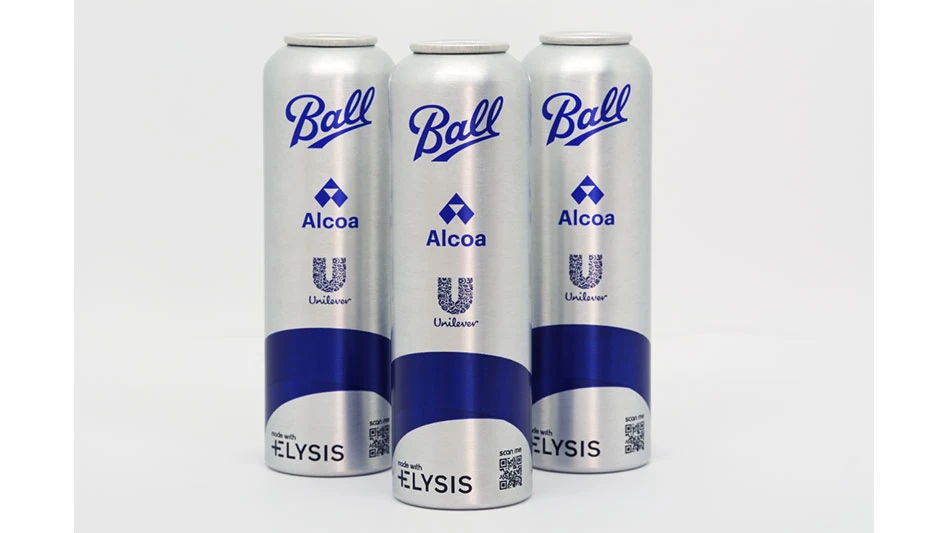
Photo courtesy of Ball Corp.
Alcoa Corp. has joined forces with Ball Corp. and Unilever PLC to use Elysis carbon-free smelting technology in consumer personal and home care packaging.
This is the first time aluminum produced using Elysis carbon-free smelting technology is being used in consumer personal and home care packaging. The resulting aerosol can, made using 50 percent Elysis primary aluminum and 50 percent postconsumer recycled content, represents one of the lowest-carbon packaging solutions of its kind, Alcoa says.
Elysis is a technology partnership created through a joint venture between Alcoa and Rio Tinto, with support from Apple and the governments of Canada and Québec. The proprietary Elysis process eliminates all direct greenhouse gas emissions from the smelting process by using inert anode technology that produces oxygen instead of CO₂. The first industrial-scale deployment of Elysis technology is underway, Alcoa says, with the goal of transforming the aluminum industry toward a decarbonized materials sector.
RELATED: Rio Tinto to install carbon-free aluminum smelting cells in Canada
This initiative serves as a model of how industries can collaborate across the value chain to accelerate low-carbon innovation, the Pittsburgh-based aluminum producer says. It also demonstrates clear alignment with global decarbonization goals and with growing consumer demand for more sustainable products.
"Through this collaboration with Ball and Unilever, we’re helping bring low-carbon aluminum into everyday products and demonstrating how innovation at the material level can deliver tangible sustainability benefits,” says Renato Bacchi, executive vice president and chief commercial officer at Alcoa. “We are proud to collaborate across the aluminum value chain to reduce carbon footprints and create real impact in people’s daily lives.”
As a founding member of the Aluminum Stewardship Initiative (ASI), Ball says it continues to lead in responsible sourcing. In 2024, 27 percent of the aluminum Ball purchased was ASI-certified, up from 21 percent in 2023, while 80 percent came from fully ASI-certified rolling mills. Over 90 percent of Ball’s global plants are ASI-certified, reflecting its commitment to transparency and continuous improvement.
"This project combines higher recycled content and low-carbon primary aluminum—both key to decarbonize aluminum packaging and the aluminum sector at large,” says Ramon Arratia, chief sustainability officer & vice president, Public Affairs, at Ball, headquartered in Westminster, Colorado. “This is both a packaging innovation and critical supply chain collaboration at work.
Latest from Recycling Today
- Phoenix Technologies closes Ohio rPET facility
- EPA selects 2 governments in Pennsylvania to receive recycling, waste grants
- NWRA Florida Chapter announces 2025 Legislative Champion Awards
- Goldman Sachs Research: Copper prices to decline in 2026
- Tomra opens London RVM showroom
- Ball Corp. makes European investment
- Harbor Logistics adds business development executive
- Emerald Packaging replaces more than 1M pounds of virgin plastic