Image courtesy of Aduro Clean Technologies Inc.
As it has continued to perfect its unique chemical recycling process for plastics, Aduro Clean Technologies Inc. has marched to a steady drumbeat of growth, methodically working through each step on the way to commercialization.
In October, the London, Ontario-based company advanced to Phase 2 commissioning of what it calls its Next Generation Process (NGP) pilot plant, also in London, and is narrowing down locations for a proposed demonstration-scale plant, which will be in Canada, Mexico or Europe.
RELATED: Aduro partners with KraussMaffei and Chill
Aduro has raised millions of dollars through private funding and grants in recent years to advance its patented Hydrochemolytic Technology, or HCT, and is publicly traded on the Nasdaq, Canadian and Frankfurt Stock Exchanges.
CEO Ofer Vicus says the company’s steady progress is measured—and communicated to investors—in simple terms.
“Every year, we start building several milestones we need to report on,” he says. “Those milestones have to be simple, reasonable, need to add value to the company and investors need to understand them. For example, if I say that this year I’m going to bring one patent, one deal and one design of a machine, then you know that by the end of the year I’m a different company than when I started.
“Every year, we either deliver or die trying. We’ve been very transparent. There’s always been overperforming versus expectations and we’ve always worked really hard to achieve those goals. I associate those goals with three items. You either give opportunity to the company, you derisk the company or you advance the company. … It’s just making those statements again and again. … The messaging has never changed. We’re just moving on the path of commercialization.”
Pushing forward
According to Vicus, Aduro officially began in 2011. Initially, the company’s focus was on upgrading heavy oil with a process he calls “pyrolysis on steroids,” where water is incorporated into a hydrothermal process to heat up oil and break apart molecules such as hydrocarbons.
Vicus describes hydrocarbons as “long and heavy” molecules associated with heavy oils that also can be found in renewable oils and plastic.
“One way or another, you need to upgrade it to a certain level, if it’s liquid, in order to change the property and increase the value," he says.
Over time and through countless experiments, the company discovered it could use a similar process on renewable oils. In 2017, the company began looking into chemically recycling plastics with the same concept and has since secured 10 patents related to processing the material. After quietly going about its business in its formative years, the company officially became public in 2020.
Aduro employs 25 people, with another 10 who are considered consultants.
“We have engineering, we have marketing, R&D [research and development], and I feel the company’s in a position to move to the next level," Vicus says. "But in the early days, it felt like we were building the plane as we were trying to fly.
“We have people in the Netherlands; we have people in Germany; we have people in Mexico and people in Vancouver. We’re a tiny company, but we’re thinking internationally. The business opportunity of the company is really significant, and it’s on us right now to show how we’re going to commercialize this work. The path is super important.”
Processing benefits
Vicus says the company’s ability to stand out in the chemical recycling realm is because of its HCT.
“Companies have been committed to pyrolysis left, right and center, and there’s a little bit of a setback now in terms of, is this the right way to go,” he says. “And then we’re just growing, and eyes are coming to us. On so many levels, 2025 has been so exciting for us.”
Eric Appelman, Aduro’s chief revenue officer and a chemical industry veteran of 35 years, cites the differences between pyrolysis and HCT.
“[In pyrolysis], you toss plastic into a reactor, heat it up and it falls to pieces," he says. "The big hydrocarbons become small hydrocarbons, and when they’re small enough they’re liquids, and you can send them off to a refinery or chemical plant.”
While Aduro does some things similarly, Appelman says that by using a catalyst, the company can process material at a lower temperature than pyrolysis, which provides some “interesting advantages.”
“We can add a little bit of water and a little bit of an organic hydroxy component or even an alcohol," he says.
"Ethanol, methanol, glycerol or even sugars would work. And then the water and alcohol, or water and sugar, generate a substance that helps us take the fragments we make of the plastics and hydrogenate them. As a result, the product we make is a saturated product and we can send that directly to steam crackers. Steam crackers love saturated products and hate unsaturated products.
“Whereas pyrolysis oil needs a big acid treatment to saturate it, which costs hundreds of dollars per ton, you can skip that with us. That’s a significant cost advantage. … If you use fossil naphtha for your steam cracker, you’re looking at a raw material cost of $600-$700 per ton. If we can skip a treatment that would cost you, say, $400 per ton, then that does weigh in.”
Appelman notes a second advantage is the water used in Aduro’s process, which can help mitigate contaminants in resins such as polyethylene terephthalate and multilayer films, among others.
“In [contaminated food packaging, for example], the water breaks [the layers] down in a different way, and as a consequence, doesn’t allow the fragments to contaminate the oil as it does on occasion in pyrolysis. So, I can separate them easily, and I can take more contaminated feedstock.”
Appelman says those multilayer films, which otherwise might be rejected and result in a loss of plastics to landfill, can be taken in by Aduro’s “much more forgiving” process.
He notes that pyrolysis requires purer feedstock, which can prove expensive, while Aduro’s ability to process more difficult-to-recycle material with a higher level of contamination potentially can save hundreds of dollars per ton.
“If you use a pyrolysis process, it’s a bit of a rough process, and it leaves you with a lot of gases which you cannot turn into products anymore,” Appelman says. “You can fire your installation with it, for example, but you’re also left with a lot of heavy molecules, which are still too big. Neither of them are desirable. You can still burn them and send the heavy ones to a refinery, and they’ll make diesel or petrol from that, but not everybody calls that recycling.
“What we do, we have the ability through our temperatures and conditions to squeeze these very large molecules, almost 90 percent, to a range that is useful for that steam cracker again. That means we have a very high yield of original carbon that is becoming available for making new plastic materials. This combination of feedstock tolerance, yields and product quality, and the lack of posttreatment, means that on each of those terms we’re saving hundreds of dollars per ton.”
Appelman adds that the recycled plastics industry has been forced to confront a wave of inexpensive virgin materials, and companies have to come up with a competitive alternative. “That is what we see ourselves doing. We believe we can arrive on a cost price for an input that is not too dissimilar to what petrochemicals have today.”
Appelman and Vicus both point out another potential advantage to Aduro’s HCT: scalability. Vicus says the equipment used in the process is off-the-shelf and can be scaled up or down by manufacturers to meet the company’s processing needs.
“Us working at a smaller scale, that means we don’t have to commit ourselves to working out of one location,” Vicus says. “We can scatter [the machinery] a little farther or closer to a site, which in turn gives you the optionality sometimes to not take as much contaminated material. We can move away from these large, expensive, centralized locations and build sites that are lighter, less capital-intensive and bring value for products that you may not want to run, traditionally.”
Investigating recyclability
In July, the company completed initial testing of synthetic turf as a feedstock for its process and claimed it was successful.
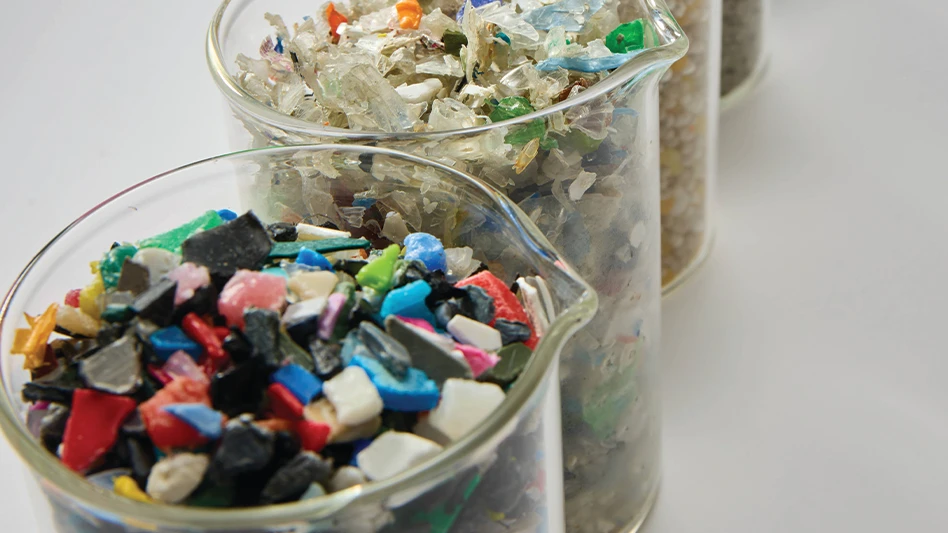
In a news release announcing the project, the company says the turf samples it used reflected the typical multilayer structure of modern synthetic turf systems, including polyethylene grass blades, polypropylene (PP) thatch layers, primary and secondary PP backing layers, residual infill materials such as silica sand and crumb rubber and polyurethane adhesives used to secure the backing and fibers.
“This complex composition, which combines multiple plastics, thermoset adhesives and inorganic materials, poses challenges for mechanical recycling and limits compatibility with conventional chemical recycling methods that rely on cleaner, more uniform input streams,” the company said, adding that testing showed its chemical recycling process selectively converted the polyolefin components of the turf into shorter-chain hydrocarbon products, which are relevant as potential feedstock for steam cracking and new polymer production.
According to the company, this was achieved without expensive preprocessing, as the process demonstrated tolerance for the mixed materials and contaminants typically present in aged turf systems.
“These outcomes contribute to ongoing efforts to evaluate the applicability of Hydrochemolytic Technology to complex waste streams that are not readily addressed by conventional recycling methods," it said.
Synthetic turf is widely used around the world in applications such as sports fields, landscaping, playgrounds, road medians, indoor facilities and more, and Aduro said that while manufacturers and recyclers have introduced take-back programs and material reuse strategies, such efforts often are constrained by technical and economic limitations. The company also surmised the successful processing of turf could apply to carpet, though it has not tested that material.
“This trial supports our strategy of targeting market segments that are underserved by conventional recycling, either due to complex material composition or limited processing scale,” Vicus said at the time. “Synthetic turf is a good example—its multilayer construction, bonded components and contamination make it difficult to process through traditional means. These are the kinds of waste streams that may be better suited to right-sized, modular chemical recycling systems like HCT.”
In May, Aduro signed a memorandum of understanding with Canadian producer responsibility organization Cleanfarms Inc. centered around the testing of HCT on agricultural scrap such as silage film, bale wrap, grain bags, netting and twine.
The road to commercialization
In October, Aduro announced that its NGP pilot plant in Ontario progressed to Phase 2 of commissioning. The plant is the latest step in the company’s scale-up pathway, designed to validate HCT in continuous operation, establish operating parameters across target feedstocks and produce product samples and data for customer evaluation.
To commission the plant, Aduro has partnered with Zeton Inc., Burlington, Ontario, and Siemens Canada, Oakville, Ontario. All major modules, including an extruder, Zeton-fabricated process skids and Siemens automation network, are installed at the facility and are progressing through staged commissioning.
“The NGP pilot plant represents the first-in-kind implementation of our Hydrochemolytic technology, and seeing it move from construction into commissioning is deeply rewarding for everyone involved,” Vicus said in an October update. “This milestone reflects the dedication and collaboration across our operations, research and senior leadership teams, people who have worked with relentless focus to bring us to this point.”
On Nov. 6, the company announced that its wholly owned subsidiary, Aduro Clean Technologies Europe B.V., had executed a nonbinding letter of intent for the proposed purchase of land, buildings and equipment associated with a brownfield industrial site in the Netherlands for 2 million euros ($2.3 million).
Aduro also will pay the vendor a nonrefundable fee of 33,782 euros ($39,269) for the exclusive use of the property during the due diligence period as it evaluates a potential home for its demonstration plant. That due diligence period runs through Jan. 15, 2026, with a targeted close on or before Feb. 28.
The company expects the decision on a final site selection will take place by January, with an operational target of early 2027.
“We think chemical recycling has its place in the world,” Vicus says. “We have to stay nimble and humble about the steps that we’re taking. This is a new tech, so it has to be proven.
“In 2025, we wanted to see our pilot built up, with [the] understanding that we could take significant steps toward the commercial demonstration unit. The pilot’s been commissioned, which means we’re standing on something we’ve been waiting for for 15 years, which is important. … A lot of eyes are going in, and a lot of curiosity, but it will cement certain realities for us as we go forward with our business model.”
Vicus says the company has learned enough that it can continue to progress as planned in the next few years. “2026 is a significant year for us. We want to run the pilot, we want to be sure that we identify how best to build a bigger unit, we want to be sure our customers are getting the answers they need, and we want to be able to present that opportunity around the world and gain that attention.
“We truly believe the company, by doing what we’ve been doing, can act as a next generation of pyrolysis. We think of it as an upgraded machine that could open new channels to process more waste plastic. If you do that, you’re doing something good.”
Latest from Recycling Today
- Phoenix Technologies closes Ohio rPET facility
- EPA selects 2 governments in Pennsylvania to receive recycling, waste grants
- NWRA Florida Chapter announces 2025 Legislative Champion Awards
- Goldman Sachs Research: Copper prices to decline in 2026
- Tomra opens London RVM showroom
- Ball Corp. makes European investment
- Harbor Logistics adds business development executive
- Emerald Packaging replaces more than 1M pounds of virgin plastic