Photo by Chris Voloschuk
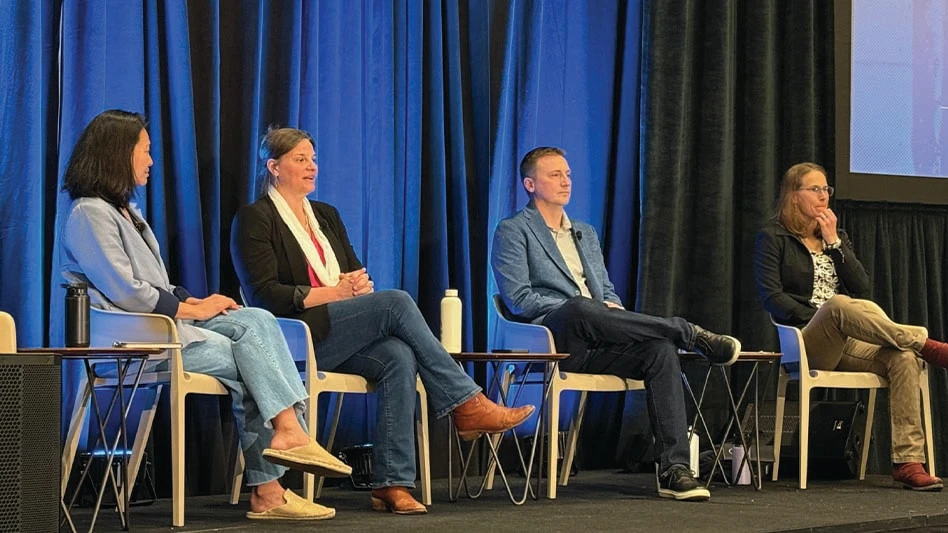
According to a panel of industry stakeholders at the 2026 Plastics Recycling Conference in San Diego, the time is now to talk about domestic demand for postconsumer resin (PCR) in the United States as extended producer responsibility (EPR) laws take shape in seven states.
Kate Davenport, chief impact officer at The Recycling Partnership, put things plainly during the Feb. 25 session, Strengthening Domestic Recycling Markets: The Critical Link for EPR Compliance, using recycled polyethylene terephthalate (rPET) as a prime example of issues the entire U.S. recycling system is facing at the moment.
“I would use the word ‘crisis’ for recycled PET bottles, thermoformed packaging, etc.,” she said. “We’ve seen about a 25 percent loss in reclamation capacity in the last 12-18 months. That’s pretty existential. If we don’t have manufacturers that want to take the bottles and clamshells and turn them into pellets, the system won’t work.”
Diving deeper, Davenport said she’s aware of material recovery facilities (MRFs) across the country with bales of PET and nowhere to send them.
“If they can’t sell their bales to be turned into pellets, that’s an existential issue,” she continued. “Some of our estimates say that we could get up to 40 percent lost capacity if we see more [reclaimer] closures.”
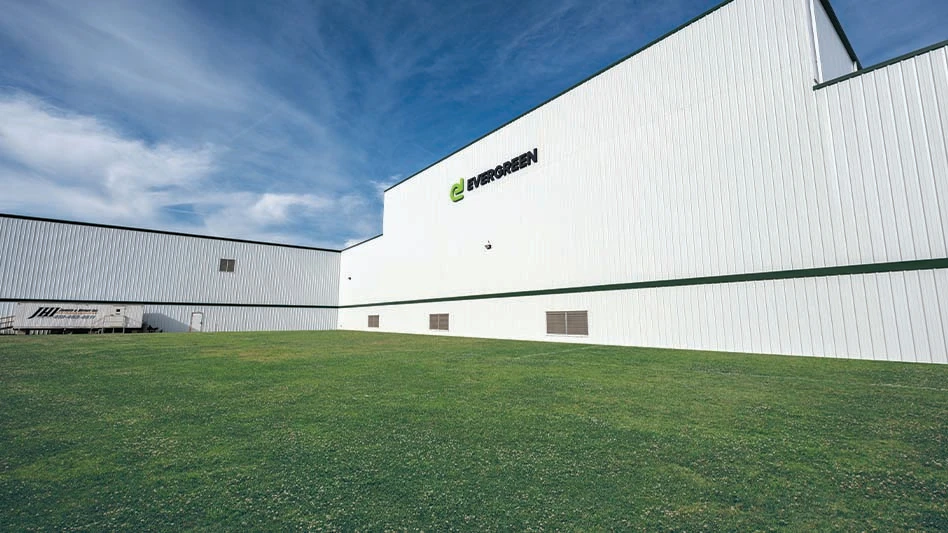
Dating back to January 2025, five different U.S. reclaimers—a critical link in PCR’s value chain—have closed. One, Clyde, Ohio-based Evergreen Recycling, closed a PET wash line at its Riverside, California, facility last year, then announced the closure of two more of its facilities Feb. 24.
Why are those closures happening? Davenport surmised it was because “the folks that are taking bales and making flake or pellet to turn into new products don’t have demand.”
Why don’t they have demand? She pointed to estimates claiming a 300 percent increase in imported resin in the last several years that costs less than domestic recycled content. Along with imports, U.S. reclaimers have struggled against an ongoing oversupply of inexpensive virgin resin.
With a packaging EPR program already underway in Oregon and six more being developed, domestic demand issues will create challenges.
“EPR is passed in seven states and, based on our projections, if EPR fulfills what we hope it does, in terms of more participation and material coming into the system, we could see a 20 percent increase in plastic packaging that needs a home as we’re seeing a 25 percent decrease in capacity right now," Davenport said. "We’ve got a supply and demand problem.”
Meeting challenges through EPR
When discussing potential levers that could be pulled to help stabilize PCR’s difficult supply and demand dynamic, Shane Buckingham, chief of staff at the Circular Action Alliance (CAA), which serves as the producer responsibility organization (PRO) implementing EPR programs in five states, said that while each state has different rules, there are ways to spur more PCR usage within the legislation.
In California, for example, he highlighted Senate Bill 54’s 25 percent source reduction requirement for all plastic packaging sold in the state by 2032. In particular, the law states that up to eight percentage points of that 25 percent total can be PCR certified by APR (Association of Plastic Recyclers) standards.
“Producers should look at that and try to maximize PCR usage in California for covered materials,” he said.
PCR targets have been set in Colorado. Buckingham noted that there are 5 percent and 20 percent PCR targets by 2030 for flexible and rigid plastics, respectively, with both jumping to 10 percent and 25 percent, respectively, by 2035.
Also, using Colorado as an example, he said if producers are able to report at a category level, they can apply for ecomodulation bonuses in that state. Another Colorado-specific lever, he said, is the opportunity for producers to purchase materials, and CAA plans to include that in its service agreements it is negotiating with service providers once the program launches in June.
In the early years of EPR programming, however, Buckingham stressed the difficulty for producers in collecting thorough data in order to apply for ecomodulation bonuses.
“We start with an incremental approach to ecomodulation,” he said. “It’s hard to get detailed reporting from producers right at the beginning. Producers are struggling with the level of complexity they already have with reporting. There are 95 categories in California, 61 categories in Colorado, 60 in Oregon, and those don’t all map consistently. There’s great variation in reporting across EPR states. One of the goals we have is to create national harmonized list that producers can use to reduce the overall burden.”
In Colorado, Buckingham said that if producers are able to report detailed data that exceeds CAA thresholds for each material category, it will apply a 5 percent fee reduction for all the material that exceeds a threshold up to $50,000.
“We need to make sure we’re doing these in step-by-step fashion that producers can manage from the beginning, then roll it out over time rather than just starting with the detailed, SKU-level reporting on Day 1.”
He said that the CAA is trying to harmonize program guidelines across the states it oversees where possible. “We’re looking to achieve [harmonization] on verification of end markets but also would like to do so for PCR. … In each state, we have the ability to use ecomodulation. In many of our discussions, we’ve indicated we’d like to see the harmonization of a PCR bonus so there’s consistency for producers using that tool.”
More to work with
The panel agreed there are ways to improve the U.S. recycling system outside of EPR’s limits. Larissa Sakamoto, director of corporate sustainability at Amcor Packaging Inc., said PCR incentives need to flow through the entire chain, so reclaimers, converters and recyclers across the country can invest in the technology needed to produce higher-quality material coveted by brands.
Noting that Amcor, a global company headquartered in Switzerland, recently set a global PCR target of 15 percent across all packaging by 2030, Sakamoto said the U.S. needs to triple the recycling infrastructure in order to reach needed recycling targets.
“At this time, we’re seeing the opposite,” she said. “It’s very concerning to us.”
She said Amcor will continue to push toward its PCR goals while trying to serve as an example for other large producers to stand firm in their voluntary commitments.
“We tripled our PCR use between 2018-2025,” she said. “We’ll strive to continue to increase PCR over the next five years. That will mean making investments in production lines, innovating packaging design to include more recycled content and continuing to work without PCR suppliers and customers that are continuing to use PCR despite the challenges. That’s how we believe we’ll reach this future. It will require more collaboration, more incentives and more innovation to make this work.”
Sakamoto said regulations, in particular, can level the playing field.
“Brands are telling us they don’t want to commit [to PCR targets], as smaller companies aren’t making the same commitments,” she said. “As leading businesses in this space, it’s up to us to demonstrate what’s possible so when the regulations come, the whole industry is ready for adoption. We can’t keep operating in a space where it’s all voluntary. We need regulations and we need incentives to make the system work.”
Davenport said that incentives baked into EPR programs are not enough to bridge the economic gap between virgin and imported resin and domestic recycled content. Rather, help could come in the form of recycled content mandates that include more traceability and transparency with regard to countries of origin for material. Additionally, she suggested the exploration of legislation at the federal level that would give tax credits to recyclers to upgrade equipment, or for companies to purchase PCR.
“We need to be talking about recycled content not just from an environmental perspective,” Davenport said. “It’s about American companies and American jobs. We need to talk about it that way, because this can be a bipartisan issue if we talk about it that way.”
The imminent threat
While urging more recycling industry stakeholders to push for PCR usage through increased dialogue with the procurement departments at consumer packaged goods (CPG) companies, Davenport also said the risk of not using recycled content should be part of the conversation.
“It needs to be translated that, ‘Hey, you should pay the 5 cents more because, on the back end, you can get this reduction in [EPR] fees,’” she said. “That hasn’t happened. That’s on us to figure out how to do that.
“We really need to express the risk. We are days away from MRFs landfilling bales of PET. This is not in six months; this is very soon. That will gain traction in the media and take us many steps backwards. That is a risk that I think exceeds the extra 5 cents per pound of procurement. We need to get that message to people. It’s a fundamental risk. It’s about American jobs and American manufacturing. I want to be a bit of an alarmist here. We need to get this message to the highest levels at some of these CPG companies.”
Latest from Recycling Today
- Kaiser lifts net income figure in 2025
- Sims’ Houston contract confirmed by Enstructure
- Benlee calls 2025 record year
- Shopping malls proposed as retail circularity centers
- APR recognizes plastics recycling leadership
- Trex announces leadership transition
- Caterpillar to launch redesigned rental management experience
- Struktol’s additives help transform recycled plastics